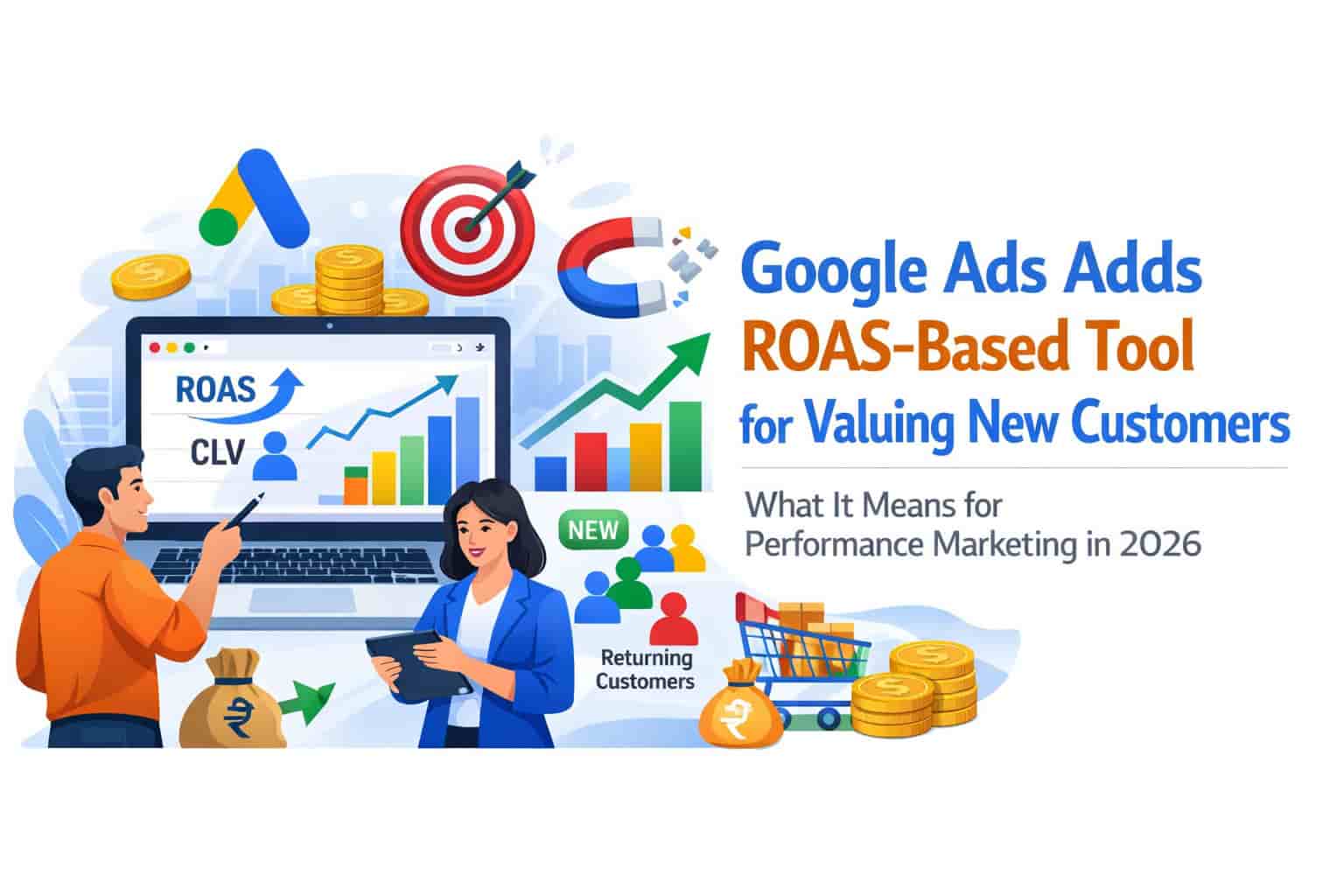
Do you continue to measure only conversions and overall return to understand your Google Ads success? If so, you might be losing sight of the bigger game. This is because not all customers were made equal and now, Google seems to be on the same note.
Google Ads introduced a ROAS-based tool to take into better account the acquisition of new customers, and the ramifications for altering the standard transaction value could change how advertisers plan their bids, budgets, and long-term growth efforts. Instead of concentrating on each conversion as equal, advertisers can now give a very lucrative value to new customers-getting them looking at the long-term growth process rather than a quick win.
In these times of escalating ad expenses and highly intelligent AI-based bid management systems, this change could not have come at a better time. Let’s take it down to the simple level and tell you why it’s vitally important for your business.
So What Is the Meaning When Google Ads Launches the ROAS-Oriented Tool on New Customers?
In simple terms, it is an update that gives scale to average Return on Ad Spend (ROAS) while providing different value allocation for new customers.
Until now, Google Ads smart bidding focused mainly on immediate revenue. However, businesses are well aware that whether in the form of retention revenue or subscription or upsell purchase, every new customer has long-term revenue. This new strategy is based on ROAS, and thus advertisers are shown to:
Place more value on first-time buyers
Set campaigns for acquiring new customers
Trumping the overall customer-value-lifetime strategy
This is like the advertiser telling Google’s algorithm, “Hey, I can budget more to get this new guy in, as the customer worth generated over his lifetime suggests.”
And thus far, Google has complied.
Now, Why Has Customer Value Lifetime (CLV) Suddenly Become So Important?
Those with their ear tuned to modern marketing trends must have realized that customer lifetime value (CLV) has taken over cost-per-click. There’s a reason for it.
Marketing is presently more cutthroat than in ever before. Businesses surviving in the marketplace are no longer buying conversions — rather, they are trying to build loyal customers.
“This new approach to paid media removes any question of whether a click is worth more or less based on cost; it takes into account long-term value,” said Priya Menon, a digital marketing analyst.
Relying on CLV while we devise strategies in paid performance marketing, the change moves us from looking at instant ROAS cleverness and keeps to long-term sustainable growth. The newest update suits this very effort.
For marketers seeking to capitalize on the strong automation trends, here’s a related piece from us on Artificial Intelligence in Digital Marketing that has something to do with Smart Bidding evolving.
How are Target ROAS-Bidding and Smart Campaigns being affected?
And this is going to get interesting.
Do note: when Google Ads initiates a tool to calculate the value attributed to new customer acquisition, it has a direct impact on the Target ROAS offerings as well as Smart Bidding automation.
Until now, campaigns have been optimized on transaction value. Now they can:
– Apply metrics regarding new customer acquisition value concordant with current strategies.
Change the bidding criteria for the audience with a higher order value.
Boost profitability throughout all your search and Performance Max campaigns.
Bigger still for eCommerce brands is the ability to have Political campaigns that are funded by private resources rather than being delivered to the public.
The long-term value potentially unlocked here for a ₹1,000 first-timer contrasts greatly to a ₹10,000 predicted long-term value engendered by a third-time buyer.
Just as the Performance Max advertising method maximizes value through machine learning and across channels in Search, Display, YouTube, and Shopping, so too could the proposed plan of heretofore unattained repository data management.
Is this a game-changer for eCommerce and lead generation marketing?
You bet i – mainly for businesses operating on a track for growth.
For eCommerce businesses, it lines up the strategy of old-school transaction-judging, not considering potential refunds.
Turning them around on the lead-generating side, you now aim at quality prospects over the spray-and-pray swarm of these human forms we call leads.
When applied properly, this novelty trait could be:
Reduction in pie-in-the-mud-but-good-for-burning advertising expense
Establishing a high rate of new customer acquirement in no time straight away.
Enhancing competitive advantage
The goal of this update speaks about Google Ads’ system changes. Here, according to the Google Ads Help Center, advertisers are given scales with which they can set value settings and revise them.
Hence, brands have more opportunity to play fairly rather than hacking their way into forced lifetime value modeling since Google’s primary bidding system is integrated with lifetime value understanding.
What marketers should be thinking about now?
So, if you are actively pushing campaigns, right now, consider doing the following instead:
Get your current conversion tracking setup audited.
They are working out what it is that you term as “new customers”, else?
Defining and working out predictions for lifetime values based on realistic estimations.
If you have your vintage data on your hands, it pays to conduct an isolated test with ROAS tying through the opportunities for you in your production products.
The updates work well in clean, accurate conditions when tracking is seamless; else get your data issues licked and start looking into using it in a more autonomous way on one of your own. Address the correct conversion management setup for your area on https://www.itechmanthra.com/blog/googleadsconversiontracking.
Besides, keep in mind that automation is very useful but is powered by the quality of the data at your disposal.
MARKETING ME: ROAS: a Historical Measure
Old, ‘traditional’ ROAS = Revenue ÷ Ad Spend
So easy.
Besides, so messed up because ROAS does not consider that every rupee in revenue will have the same long-term value, which we all do know is not true.
However, suppose we were to say that ROAS does matter here. Oh, Google is working on paid ads’ new ROAS-based feature for evaluating the value of new customers.
No more are earnings measured only for the quick win.
ROAS brings about a strategic measure.
This is the biggest shift in ad nature ever considered.
FAQs
What is this new ROAS-based tool on Google Ads?
It lets advertisers apply a higher value to new customers for Target ROAS bidding, thereby enhancing acquisition-focused optimization.
How is it different from average ROAS?
Your usual ROAS usually treats all conversions equally. This new-model though lets you look at customer lifetime value too.
Is this good for small businesses?
Yes, especially if you are having a business structure that relies on repeat purchases.
4. Do-Performance Max strategies work together with Performance Max strategies?
Yes, this is integrated with Smart Bidding strategies and Performance Max strategies.
5. Is it advisable to change over all the campaigns to this model?
Not now. It is advisable to implement a controlled performance test of this strategy in pre-existing campaigns, alongside the current benchmarks.
Conclusion
This biographical update on new customer ROAS tools coming to Aga is most significant to the growth narrative. This is a cold-hearted message from the search engine concerning the great movement of modern methods, meaning infinite margin.
And if you care enough to start thinking about customer lifetime value, today is as good a day as any!
Do you think it would influence the way you manage your Google Ads strategies? Any thoughts or questions? Do not hesitate; comment. Let us discuss.