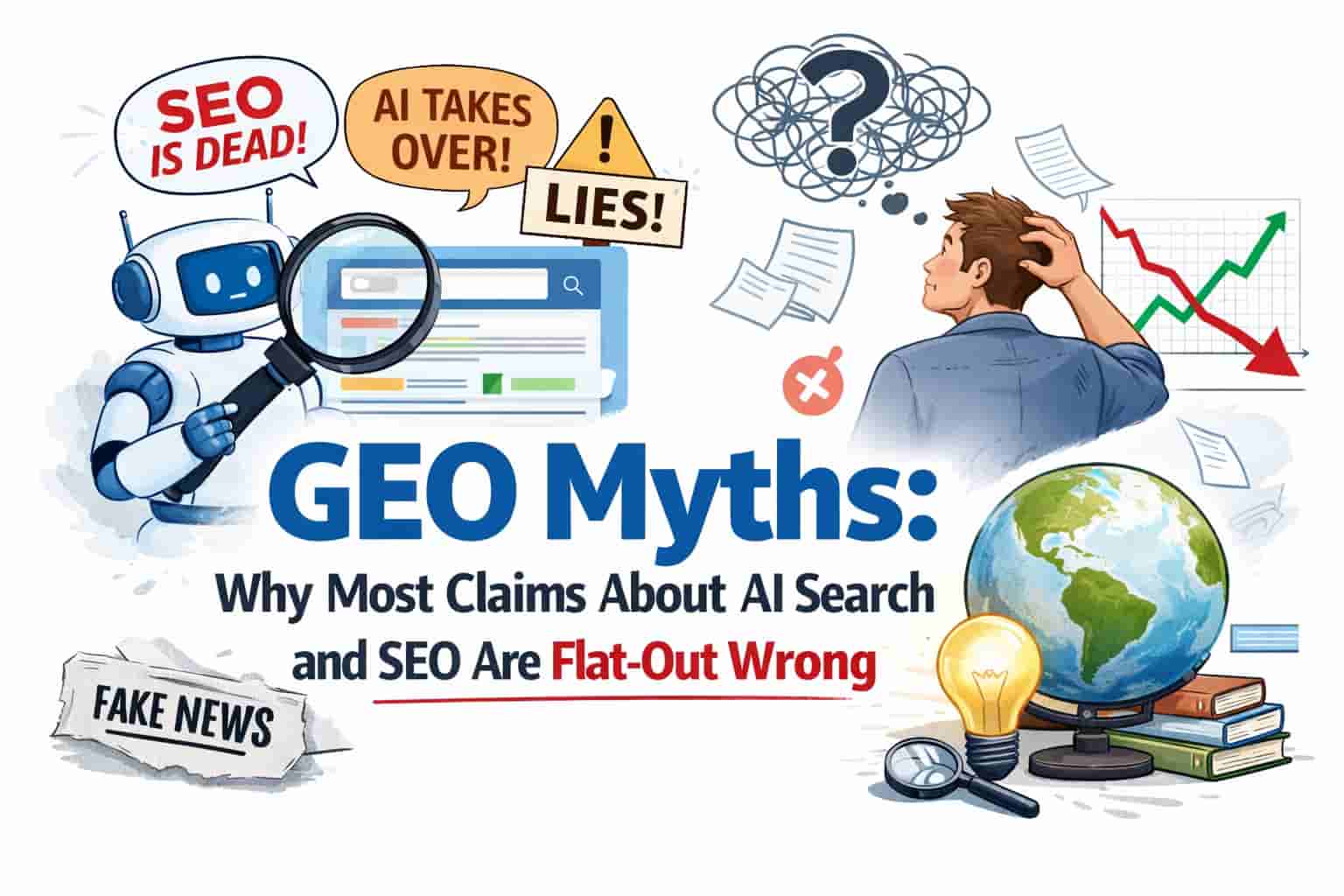
Introduction: Are We Already Being Lied to About GEO?
LTo be honest, whenever Google does something new, the internet is abuzz with hysteria. Blogs scream, LinkedIn group threads are burning, and everybody proclaims themselves an expert. The same is happening with GEO myths today.
You may have heard things like “SEO is dead,” “And now AI controls everything,” “You no longer care about keywords,” etc. Pretty dramatic push-it-out-there-or-else,’” huh? In many cases these GEO myths are downright false, or even at best, half-truths taken completely out of context. And believing them can bear dire consequences in the realms of visibility for those who are marketers, founders, and content creators.
So let’s delve deep into what GEO actually means, what’s being misconstrued, and most importantly, what actually has value now.
What Is GEO, really, and Why So Many Myths?
As search experiences like Google AI Overviews and generative answers become commonplace, GEO is becoming a term of interest. Instead of merely letting blue links rank, content is now subject to summarization, rewriting, or annotation by AI.
Here’s where the myths begin. Many people assume GEO replaces SEO. It doesn’t. Others believe AI search removes traffic opportunities entirely. Also false. The confusion exists because AI search optimization is new, fast-moving, and poorly explained.
As SEO consultant Mark Danton puts it, “Every major search shift creates fear first, clarity later. GEO is no different.”
Is Traditional SEO Really Dead Because of GEO?
Short answer: no. Long answer: absolutely not.
One of the biggest GEO myths floating around is that classic SEO practices no longer matter. In reality, traditional SEO best practices like crawlability, internal linking, topical authority, and structured content still power AI systems.
AI doesn’t invent information. It pulls from content that already ranks well, is trusted, and is easy to understand. If anything, SEO for AI search depends even more on clean structure and clear answers.
If you’ve been following our breakdown on how AI is reshaping search behavior, you’ll notice the same pattern: SEO isn’t dying, it’s evolving. (Internal link suggestion: AI search impact on SEO article on itechmanthra.com)
Are AI Overviews Stealing All Organic Traffic?
This myth is partly true and mostly exaggerated.
Yes, AI Overviews impact organic traffic, especially for simple, informational queries. But they don’t eliminate it. Complex searches, comparisons, opinions, and deeper insights still drive clicks. In fact, AI summaries often pull from authoritative pages, increasing brand visibility even when clicks drop slightly.
Smart publishers are adjusting by:
Answering questions clearly at the top
Using concise definitions
Structuring content with helpful subheadings
Building topical authority across multiple articles
This is where search engine myths can really mislead businesses into making panic-driven decisions.
Does GEO Mean Keywords Don’t Matter Anymore?
Another lie wrapped in confidence.
Keywords still matter, but how you use them matters more. Instead of stuffing exact phrases, AI prefers natural language optimization, semantic relevance, and contextual depth. That means your content should sound human, not robotic.
For example, instead of repeating one keyword endlessly, strong GEO content naturally includes related terms like:
AI search optimization
Generative search engines
Content visibility in AI results
Search experience optimization
If you’re already optimizing content properly, GEO isn’t a threat, it’s an advantage.
What Are Brands Getting Wrong About GEO Right Now?
The biggest mistake brands make is chasing shortcuts.
Some are rewriting content purely for AI without considering readers. Others are ignoring content quality and focusing only on tools. That’s risky. AI systems reward content that feels credible, helpful, and genuinely written for people.
As content strategist Nina Lopez explains, “AI won’t replace good content, but it will expose bad content faster than ever.”
Brands that win with GEO myths exposed are the ones doubling down on clarity, expertise, and trust signals, not gimmicks. If you’re refining your content strategy, this pairs well with our guide on building topical authority for long-term SEO growth. (Internal link suggestion: topical authority SEO strategy article)
How Should You Actually Optimize for GEO Without Falling for Myths?
Here’s the grounded approach most competitors agree on:
Keep writing for humans first
Answer questions clearly and early
Use structured headings and summaries
Strengthen internal linking
Maintain E-E-A-T signals (experience, expertise, authority, trust)
AI systems learn from high-quality sources like Google Search Central documentation and trusted industry publications, not from thin or sensational content. That’s why chasing myths rarely works long term.
FAQs About GEO Myths and AI Search
Is GEO replacing SEO completely?
No. GEO builds on SEO fundamentals rather than replacing them.
Are AI Overviews bad for websites?
Not always. They reduce some clicks but increase visibility and brand trust.
Do keywords still matter in AI search?
Yes, but they should be used naturally and contextually.
Should I rewrite old content for GEO?
Only if it lacks clarity, structure, or updated information.
What’s the safest GEO strategy right now?
Focus on high-quality, human-written content with clear answers and strong internal linking.
Conclusion: So, Are GEO Myths Hurting Your Strategy?
Maybe, if you don’t question them.
SEO doesn’t come to an end with GEO; it’s really only just begun. AI is a real danger but not misinformation. A clear focus on creating clear content, real expertise, and honest optimization will ensure your success in protecting your sites from being drowned in AI-driven search.
If this article has cleared your head on anything, please feel free to like or share with your networks, drop a comment, or tell us about any GEO glimpsed in this list which you believe is but sheer mythology.

Kumar Swamy is the CEO of Itech Manthra Pvt Ltd and a dedicated Article Writer and SEO Specialist. With a wealth of experience in crafting high-quality content, he focuses on technology, business, and current events, ensuring that readers receive timely and relevant insights.
As a technical SEO expert, Kumar Swamy employs effective strategies to optimize websites for search engines, boosting visibility and performance. Passionate about sharing knowledge, he aims to empower audiences with informative and engaging articles.
Connect with Kumar Swamy to explore the evolving landscape of content creation!