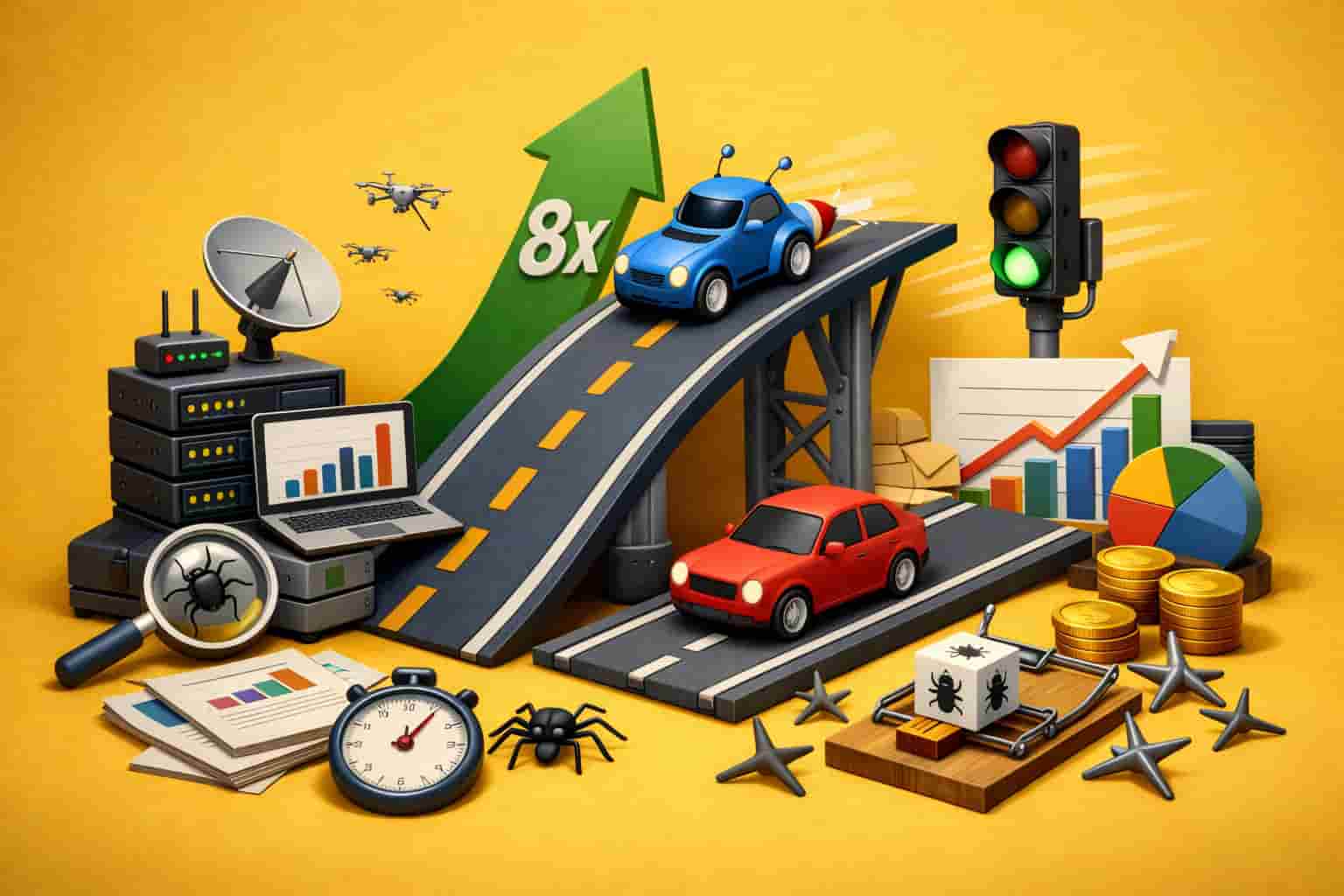
Silent revolution is taking place as bots are no longer just in the background anymore but are fast becoming the more significant entities in that realm called the web. This is alarming since automated traffic, we are told by statistics, is growing by a factor of eight in comparison with human traffic. This isn’t just a security issue; it’s a marketing issue, an analytic issue, and a strategy problem. Just letting your dashboard or website still record “a visitor = a person” is a basis for wrong thinking.
A significant portion of your traffic could be coming from anything but humans, skewing all the data used for performance measurement
Not all bots are completely bad; some bring their own sets of benefits, including driving discovery (AI crawlers and search bots) while others are simply siphoning off the budgets
Small businesses place themselves in a higher degree of risk than they believe. Fewer filters, less-watched monitoring, and higher impact.
What does “8 times faster for bot traffic” actually mean?
The short answer is that bot traffic isn’t just increasing; it is itself accelerating while far striding beyond humans in growth. This thus means that your analytical base is changing subtly due to the existence of improved computational prowess.
While it may seem spectacular, the thing that really hits you hard is that your data is now less reliable.
In the past, bot traffic was considered spam traffic to filter out. Nowadays, they are just an integral part of the web. AI crawlers, scraping tools, price bots, SEO audit bots, and malicious scripts are among the tools that make those numbers seem even humane.
But the thing is,
most tools, including the setup of Google Analytics, have not exactly figured out how to discern automatically between human and robot behavior.
The problem is:
- Deteriorated page views
- Reduced session duration
- Misleadingly high bounce rates
- Fraudulent conversion signals
So even though you’re probably optimizing campaigns against this five-gallon bucket of noise.
Bite-size soundbite: It’s not robots that are the problem; it is the fact that they are developing human characteristics in your data.
What would small businesses care about when it comes to bot traffic?
Short answer: Because bots do not just inflate the numbers. They populate the budget, ROI, and decision-making with what might still be considered as fodder at the scale of small teams.
Large corporations have the teams, tools, and budgets to sift through it all. You probably don’t.
This is precisely why this shift is more important for smaller and medium-sized enterprises.
These are the areas where bots hurt you the most:
- Paid Ads Waste
- Ads eat up your spend with their click bots and fraudulent traffic
- You are paying for those impressions and clicks that never convert.
- Conversion Rate Distortion
- Bots land on your landing pages but never convert
Your CVR got destroyed → you think your ad creative or targeting is at fault
- SEO Misinterpretation
- Bots and crawlers drive your website visits and page view numbers up
- You will think a page is performing when, in reality, it is being scraped
- Server & Infrastructure Load
- Higher bot traffic = higher server costs
- Slower performance to legitimate users
- Real-life example (not from the source)
While running Meta ads, a D2C skincare brand noticed an abrupt spike in traffic against zero conversions. Further exploration revealed:
~28% of the traffic was coming from suspicious IP clusters
Bounce rate went up from 52% to 78%
The ROAS in the report improved by 34% when bot-heavy segments were removed.
Their ads were not fixed; their data was fixed.
Memorable conclusion: To small business owners, bot traffic is not just some random disturbance but a sort of income stealing.
Are bots basically bad? Or are some actually good?
Short answer: Some bots are not harmful; some of them are imperative, while some of it is getting out of control.
We have the bad habit of considering all bots together, although they should be divided into three broad categories:
Good Bots (You will want these) You should proceed cautiously with good bots available:
- Search engine crawlers (Googlebot, Bingbot)
- AI crawlers indexing your content
- SEO audit tools
- These will greatly help you to get noticed.
Neutral Bots (Case-to-case-basis) You will need to moderate relation to these bots:
- Price comparison bot
- Market research scrapers
- Competitive intelligence tools
- These don’t do direct harm but extract value.
Bad Bots (A-No in Your Book) You must keep them under your scanners:
- Click fraud bots
- Credential stuffing scripts
- Content scrapers
- Fake traffic generators
They mess up data and cost money.
Comparison Table: Bot Types and Their Impact
| Bot Type | Primary Purpose | Impact on Business | Action Needed |
| Search Crawlers | Index content | Positive (SEO visibility) | Allow |
| AI Crawlers | Train models / index data | Mixed (visibility + data use) | Monitor |
| Scraper Bots | Extract content/data | Negative | Block |
| Click Fraud Bots | Fake ad clicks | Highly negative (cost) | Block urgently |
| Monitoring Tools | Analyze site performance | Neutral | Allow/limit |
| Competitor Bots | Price/market analysis | Competitive risk | Monitor |
Big takeaway: The ultimate goal is not to shut down bots, but to control which ones engage with you.
What are the consequences when bots are given an SEO/AI visibility profile?
Bots are no longer about just crawling your site and indexing it but about manipulating your content for reuse, summarizing it, and presenting it in AI-driven results.
Things get interesting.
Search is transitioning from “links” to “answers.” Answers are often generated by bots who have crawled their content.
Here is what it means AI-crawlers come to your site, and they extract your content and summarize it in some other area.
- It’s always a bit of both a loss in clicks alongside tremendous utility.
- A certain level of uncertainty exists about attribution
- An area that went unaddressed in the original conversation
- The core issue the report is focusing on isn’t growth rates, but who controls the data.
Nowadays, there’s no more competition just for rankings. You have to:
- Show up in AI summaries
- Elaborate from an answer generated
- Gain visibility without click-through
The paradox is that:
- If bots get smarter → more exposure.
- If more exposure → fewer direct visitations
A strategic shift calls upon us to change the way we frame traffic:
Instead of enquiring,
“How can I receive more and more traffic?”
ask yourself,
“How can I be mentioned in traffic redistribution?”
In brief: Bots do not measure content in the AI era; they just react to it.
How to detect and eliminate bad bot traffic?
Simple answer: Multi-layer detection is essential, since analytics filters fell short; behavioral signals, IP filtering, and server-side protection should be used together.
Here comes a scenario:
- How so: Prepare an industrial framework against bot traffic
- 1st Step: Audit for Analytics Anomalies
- Look for traffic spikes with low engagement
All of a sudden, there will be real spikes from some unusual geographies
- Segment your traffic based on behavior
- 100 percent Bounce rates
- 0-second sessions
- Unrealistic repeating intervals of sessions
- Filters required for some agencies in specific sites
- Bot filtering needs to be established in analytics
- Observed bot filtering in Google Analytics4
- Supporting activities with web server logs
- Deploying web application firewall (WAF)
- SetUp tooling such as Cloudflare and AWS Shield
- Keeping an eye out for suspicious IP ranges
- Exercise rate limiting
- Interrupt any repeated widespread requests
- Guarding login as well as application programming interfaces
- Constantly look at the quality of ad traffic
- Distinguish how clicks differ from conversions
- Leverage click-fraud analysis tools
- Bots are shown in real scenario activity
- Examination of server logs
- Action is Bot Real Action-being seen live
- Not Spy Dashboards
- Where Most Teams Fail
- Only Google Analytics
- No-cap On-site Security System
- The enemies source is said to pollute data in analytics.
Turn bots overshadow internet culture?
The monosyllabic answer is in the affirmative up to one-half of the truth but that traffic will alter meaningfully.
Towards the hybrid internet, we are moving.
- Human browsing
- AI agents fetching and summarizing
- Bots interacting with APIs instead of pages
In that world:
- Pageviews matter less
- Data access means more
- Brand presence spills beyond your website
- The Counter-Argument (It is important)
Many sources claim that the rise in bot traffic is inflating:
- Improvement in its detection techniques
- Many of the bots are legitimate instruments (AI, searching, SaaS tools)
- The “bad bot” share, therefore, may not increase in step
- Fine enough but that misses the bottom line.
When AI robots are given queries to answer but do not transfer traffic to your site, your traffic goes down, even when your influence is going up.
Implications for content:
Optimize visibility, not just clicks
Track quality of engagement not just volume
Build up first-party data channels: email, community, CRM
Quote: the future that is not about bot against human but about bots deciding how humans reach to your business.
Overall change: traffic onboarding is more important than traffic acquisition to marketers.
In short: best most things time should be on obtaining traffic, reallocating most of it to see that the right traffic mainly be human and valuable.
This pivotal transition is yet to effect a huge percentage of setups.
Old Thinking:
* *More session= better performance**
New Thinking:
- The better the session, the better the performance.
Focus on:
- The usefulness of metrics over numbers
- Sessions that involve a commitment
- Sessions that create conversion–A good traffic thermophile
- Systems which are aware of bots
- Segment human and suspicious traffic separately
- Always adjust your KPIs accordingly
- Guys help me remember our first model of attribution.
- Discover attribution. Not all foot steps need to be counted.
Maybe have them talk much more on that first?
Some proper content strategies in the age of AI
Medium: structured, quotable, and scannable content that suits both machineries and humans
Conclusion: “Automated traffic is growing eight times faster” may sound just like one of those tech trends. But no.
It’s a clue that your audience isn’t just individuals anymore, but rather its systems that filter, decode, and redistribute content before ordinary people even see it. Regardless of how you are still just looking after the raw traffic, you are playing quite a dated game. The next marketers that will prevail will not chase traffic; they will control its quality, context, and downstream influence.

Kumar Swamy is the CEO of Itech Manthra Pvt Ltd and a dedicated Article Writer and SEO Specialist. With a wealth of experience in crafting high-quality content, he focuses on technology, business, and current events, ensuring that readers receive timely and relevant insights.
As a technical SEO expert, Kumar Swamy employs effective strategies to optimize websites for search engines, boosting visibility and performance. Passionate about sharing knowledge, he aims to empower audiences with informative and engaging articles.
Connect with Kumar Swamy to explore the evolving landscape of content creation!