Introduction
In the last ten years, AI image generating has developed through the interactions of trivial visual filters to extremely advanced systems that can create realistic and context-aware images. Previously viewed as experimental, now this is already a part of daily consumer technology, whether it is photo enhancement or generative design tools. With this development, the general population has been fascinated by the advances in predictive AI technology because they want to know how algorithms take into account the future or other hypothetical events.
Baby face generation using artificial intelligence is one of the new examples of this trend. These tools are not meant to be considered just as entertainment, but represent more profound technological changes in the field of facial synthesis AI, probabilistic models, and generative AI tools. Their development emphasizes the fact that modern AI image generation is at a new stage, which is based on prediction, simulation, and visualization as a user option.
The Evolution of AI Image Generation
The initial AI picture application utilized pre-existing filters and rule-based transformations. Although they could be attractive, they were not very adaptable and realistic. The development of generative adversarial networks (GANs) represented a new breakthrough because it allowed models to acquire sophisticated visual patterns with the help of large amounts of data. The GANs enabled machines to create images that were very similar to real-world photography and this made a huge contribution to the field.
Diffusion models and deep learning architectures have more recently changed AI image generation. These systems operate such that the noise is slowly removed to create the coherent images which are of higher fidelity and more nuanced. Diffusion-based methods have now formed the basis of the latest generative AI applications and allow the user to exercise more control over facial structure, lighting, and expression. This development has provided the foundation of applications that extend beyond the generation of art to predictive and analysis space.
How AI Baby Face Generation Works
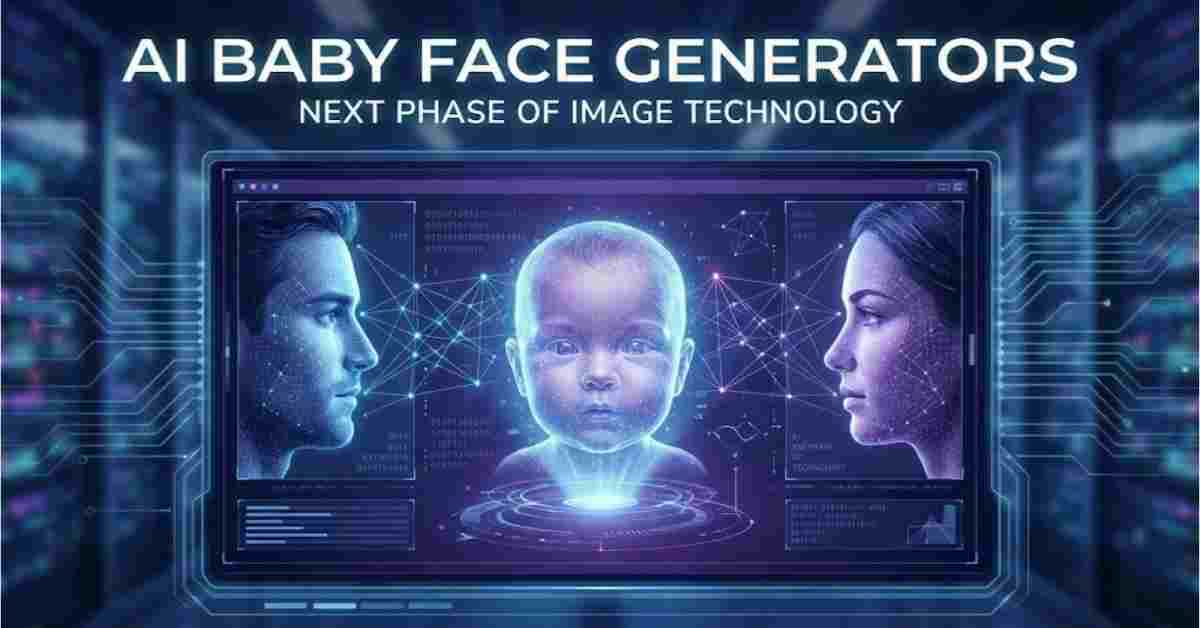
AI baby face generation is an approach that integrates facial synthesis AI with statistical predictor models. The process normally starts by extracting facial features, where algorithms extract the most important landmarks including the shape of the eyes, the structure of the nose, and the jaw position. These systems often rely on deep neural networks to analyze facial structure and skin tone, creating a foundation that allows the system to perceive visual variations and similarities.
Then, data modeling techniques are used to estimate ways of how features can mix or develop. The system does not provide deterministic predictions, but probabilistic ones are employed to produce several realistic results. This method illustrates the overall trends in predictive AI technology in that the uncertainty is not neglected.
Some platforms, such as an AI baby face generator, illustrate how these models blend visual attributes using diffusion-based synthesis and large-scale facial datasets. From a technical perspective, these tools demonstrate how AI image generation can simulate hypothetical scenarios while maintaining visual coherence and realism.
Use Cases in Consumer Technology
AI baby face generation is a synthesis AI of faces with statistical prediction models. The first step is usually the face feature extraction and algorithms examine important markers of the face, including eye shape, nose structure, and jaw alignment. Such features are represented as mathematical values that enable the system to learn about similarities and differences of visuals.
Then the data modeling techniques are used to make estimations of how features may mix or develop. The system does not make deterministic predictions; instead, it makes probabilistic predictions to provide a segment of plausible results. This methodology is representative of larger patterns in predictive AI technology, in which uncertainty is not disregarded.
Ethical, Privacy, and Data Considerations
Like any facial synthesis AI, ethics is imperative. Image consent is still one of the major concerns especially when authentic facial data is being used to train or produce results. Developers are expected to make sure that the data they base their creations on is obtained in a responsible manner and to ensure that the information collected by users remains safe.
There are also problems with bias and accuracy. In case of non-diversity of training data, produced faces could represent biased or unnatural results. To deal with such problems, the model evaluation should be transparent and advanced continuously. AI development is conducted in a way that is responsible and advocates fairness, explainability, and awareness to users, so that predictive AI technology is implemented without being sensational.
Future Outlook for Predictive Visual AI
In the future, predictive visual artificial intelligence will become more integrated with newer technologies like augmented and virtual reality. Facial synthesis in AR and VR worlds might help provide immersive experiences, customizable avatars, and aging characters. These features can be spread to wider consumer software, affecting gaming, education and digital communication.
These technologies will become more and more regulated and transparent. Strict rules on how data is used, disclosed and algorithmic accountability will contribute to establishing confidence among the population and also aid in innovation. With AI image generation still in its developmental stages, predictive tasks such as baby face synthesis provide an insight into how the field of AI and its use in visual art will influence the future landscape of the digital experience.
Conclusion
The next stage of AI image generation is represented by AI baby face generators, in which the concepts of prediction, simulation, and interaction with a user are merged. Through the use of state-of-the-art generative AI systems and facial synthesis AI, these systems illustrate the way predictive AI technology is going beyond fixed imagery. The future influence will rest on responsible development, ethics, and informed adoption throughout consumer technology.

Nishanth Kumar is the Lead SEO Strategist at iTech Manthra. With over a decade of experience in the digital marketing landscape, he specializes in technical SEO, link-building strategies, and search engine algorithms. Nishanth has helped hundreds of businesses scale their organic presence through data-driven marketing and sustainable “white-hat” techniques. He is passionate about decoding Google’s ever-changing updates to help brands stay ahead of the competition.