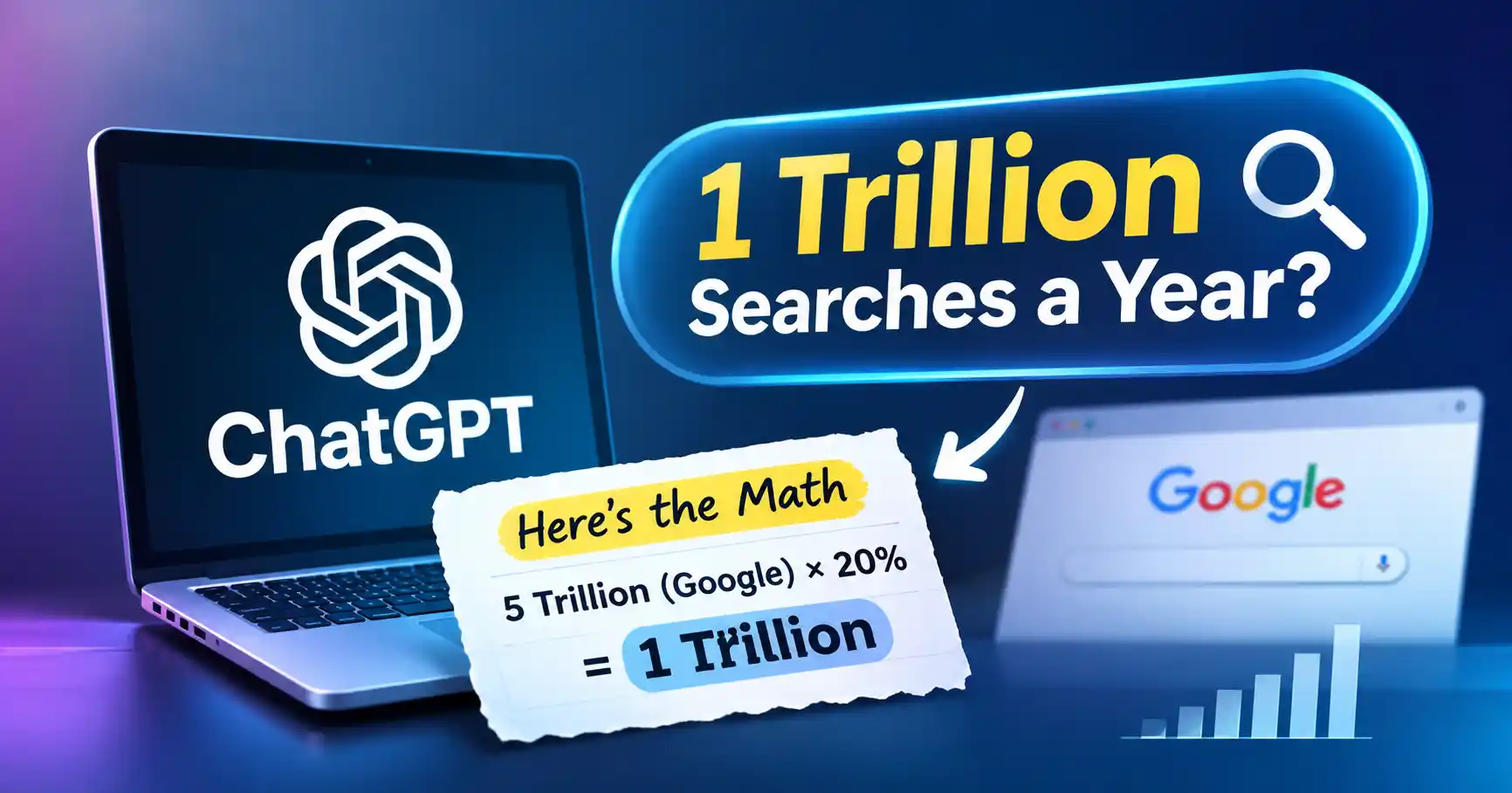
ChatGPT may be handling far more search activity than many people realize. OpenAI recently said its search like query volume has reached approximately 20% of Google’s search volume. That figure raises an interesting question: Is ChatGPT really handling 1 trillion searches a year?
The number sounds massive, but the math behind it isn’t complicated. What matters more is understanding what OpenAI counts as a search, how the estimate was calculated, and whether it’s fair to compare ChatGPT directly with Google.
For bloggers, content creators, and digital marketers, this isn’t just another AI statistic. It offers a useful perspective on how people are changing the way they find information online.
Where Did the 1 Trillion ChatGPT Searches Claim Come From?
The trillion search estimate comes from a comparison shared by OpenAI, rather than an independently published annual search count.
On November 2, 2026, OpenAI consumer product lead Adam Fry said ChatGPT handles roughly OpenAI’s 20% Google search comparison . Search Engine Land and other technology publications reported the statement.
That comparison matters. It suggests ChatGPT has become a significant destination for people looking for information.
What OpenAI Actually Said
OpenAI described ChatGPT’s search activity as approximately 20% of Google’s search volume.
However, the company didn’t publish a complete annual search count alongside that comparison. It also didn’t explain every detail of how the Google baseline was measured.
There’s an important distinction here: comparing search volumes as a percentage isn’t the same as publishing an independently audited search total.
How the Trillion Search Estimate Is Calculated
The estimate uses Google’s previously disclosed search volume.
Google reported in 2025 that it was processing more than 5 trillion searches annually. Applying OpenAI’s 20% comparison to that figure gives us:
5 trillion × 20% = 1 trillion
That’s the calculation behind the headline.
But there’s a catch. The result is an estimate derived from two figures, not an official annual search total independently confirmed by OpenAI.
The calculation also assumes both companies are counting comparable search activity.
How Many Searches Does ChatGPT Handle Per Year?
Using Google’s 5 trillion annual searches as the baseline and applying OpenAI’s 20% comparison produces an estimated 1 trillion ChatGPT search like queries annually.
Here’s what that estimate looks like when broken down:
| Measurement | Estimated volume |
| Annual | 1 trillion |
| Monthly average | 83.3 billion |
| Daily average | 2.74 billion |
| Hourly average | 114 million |
These figures are mathematical calculations based on the annual estimate. They aren’t independently measured ChatGPT search counts.
Why This Is Not an Official Search Counter
OpenAI’s comparison refers to search like queries, not every message sent to ChatGPT.
According to Search Engine Land, OpenAI considers searches to be questions people would traditionally ask a search engine. These include requests for current information about people, places, finance, and health.
That means the trillion search estimate shouldn’t be interpreted as one trillion users, conversations, or ChatGPT prompts.
For example, asking ChatGPT to rewrite an email isn’t necessarily a search. Asking it to find the latest smartphone prices and triggering a web search is a different kind of activity.
This distinction becomes especially important when comparing AI usage with traditional search engines.
ChatGPT vs Google Search Volume: What the Numbers Show
Google vs ChatGPT search volume, but ChatGPT’s reported search activity is becoming increasingly significant.
Google disclosed more than 5 trillion annual searches in 2025. OpenAI’s November 2026 comparison puts ChatGPT’s search like activity at approximately one fifth of Google’s volume.
Still, independent estimates have produced different results.
| Source | Estimated ChatGPT search volume relative to Google |
| OpenAI, November 2026 | 20% |
| Ahrefs, February 2026 | Approximately 12% |
| SEOClarity, October 2026 | Approximately 7.5% |
These estimates aren’t directly comparable. Each uses a different period, classification, and research methodology.
Why Independent Estimates Differ
Ahrefs estimated that approximately 65% of ChatGPT prompts represented activities people traditionally performed on Google. Its calculation used ChatGPT’s previously disclosed 2.5 billion daily prompts from July 2025.
SEOClarity took a different approach, estimating approximately 1.24 billion daily search equivalent messages, or 7.5% of Google’s query volume.
OpenAI’s newer comparison focuses on queries that trigger web searches. That definition may not align with either independent methodology.
The takeaway isn’t necessarily that one estimate is wrong. It’s that ChatGPT search volume depends heavily on what researchers classify as a search.
Are ChatGPT Prompts and Search Queries the Same Thing?
No. Understanding this distinction is essential when interpreting ChatGPT search statistics.
A prompt is an instruction or question submitted to ChatGPT. A search query is an information request that results in a search.
Consider a few examples:
| ChatGPT request | Search like activity? |
| Rewrite my email professionally | Usually no |
| Explain compound interest | Not necessarily |
| Find the latest iPhone prices in India | Likely yes |
| Compare today’s gold prices | Likely yes |
| Summarize this uploaded document | Usually no |
A single conversation can also involve multiple searches.
Imagine someone asking ChatGPT to compare three laptops, check their current prices, and recommend the best option for video editing. Depending on how ChatGPT processes those requests, the conversation could trigger several searches.
This makes accurate measurement more complicated. One conversation doesn’t necessarily equal one search.
For marketers, comparing total ChatGPT messages with Google’s search queries without accounting for intent can lead to misleading conclusions.
Does ChatGPT’s Search Growth Mean Google Is Losing Users?
Not necessarily.
ChatGPT is expanding the ways people discover information, but growing search activity doesn’t automatically mean users have abandoned Google.
Someone might use Google to discover websites, ChatGPT to compare options, and Google Maps to find a nearby business. These platforms can serve different purposes throughout the same buying journey.
Search Volume vs Website Traffic
This distinction matters particularly for publishers.
Ahrefs’ February 2026 analysis estimated that Google and ChatGPT website traffic comparison across its analyzed dataset.
A search like question answered inside ChatGPT doesn’t necessarily result in a website visit.
For example, someone asking for the definition of SaaS might get a complete explanation without clicking any sources. Another person researching the best SaaS billing platforms may visit several websites to compare products and evaluate features.
More search activity doesn’t automatically translate into more referral traffic.
For additional context, iTechManthra has covered Google vs ChatGPT search volume and the relationship between ChatGPT and Google traffic data.
What ChatGPT’s Search Growth Means for SEO
The growth of AI search doesn’t make traditional SEO irrelevant. It means businesses need to think about visibility across more discovery platforms.
Why Google SEO Still Matters
Google remains a major source of website discovery and referral traffic.
Businesses should continue focusing on established SEO fundamentals:
- Publish useful, accurate content that addresses genuine audience needs.
- Make important pages accessible to search engines.
- Improve website speed, usability, and mobile experience.
- Use descriptive titles and clear heading structures.
- Build relevant internal links between related pages.
- Monitor organic traffic, conversions, and search performance.
Google’s own guidance emphasizes helpful, reliable, people first content rather than pages created primarily to manipulate rankings.
How Businesses Can Improve AI Search Visibility
AI search visibility is worth monitoring, especially for brands that depend on online discovery.
Here’s a practical approach:
- Answer specific questions clearly. Explain products, services, pricing, and industry concepts in language customers understand.
- Build topical depth. Create connected content that demonstrates expertise instead of publishing isolated keyword focused pages.
- Keep information accurate. Update outdated product details, statistics, and claims.
- Strengthen brand credibility. Maintain consistent company information and credible references across relevant websites.
- Track referral traffic. Identify visits originating from ChatGPT and other AI platforms in analytics tools.
- Measure business outcomes. Track leads, sales, and conversions instead of relying solely on visibility estimates.
Google’s guidance for generative AI search also emphasizes unique, valuable content and established SEO fundamentals rather than shortcuts or artificial optimization tactics.
FAQ’s
The estimate is mathematically plausible based on OpenAI’s reported 20% comparison with Google’s more than 5 trillion annual searches. However, OpenAI hasn’t published an independently verified annual search counter confirming exactly 1 trillion searches.
The trillion search estimate translates to approximately 2.74 billion search like queries daily. This is a mathematical average, not a directly measured daily count.
No. OpenAI’s statement refers to search query volume relative to Google, not 20% market share. Search volume and market share are different measurements.
Not entirely. People use ChatGPT for conversational answers and research while continuing to use Google for website discovery, local searches, shopping, navigation, and other purposes. The platforms increasingly overlap, but they aren’t identical.
Conclusion
The math behind the ChatGPT trillion search estimate is straightforward: apply OpenAI’s reported 20% comparison to Google’s more than 5 trillion annual searches.
Interpreting that number, however, requires more care.
OpenAI’s comparison doesn’t establish an independently verified annual search count. Different research methodologies produce different estimates, and search volume doesn’t directly translate into website traffic or market share.
For businesses and content creators, the practical takeaway is simple: don’t abandon Google SEO just because ChatGPT’s search activity is growing. Focus instead on creating content that earns visibility across traditional search engines and AI powered discovery experiences.
Ultimately, the more useful question isn’t just how many searches ChatGPT handles. It’s whether your business can become a trusted source when customers turn to these platforms for answers.

Kumar Swamy is the CEO of Itech Manthra Pvt Ltd and a dedicated Article Writer and SEO Specialist. With a wealth of experience in crafting high-quality content, he focuses on technology, business, and current events, ensuring that readers receive timely and relevant insights.
As a technical SEO expert, Kumar Swamy employs effective strategies to optimize websites for search engines, boosting visibility and performance. Passionate about sharing knowledge, he aims to empower audiences with informative and engaging articles.
Connect with Kumar Swamy to explore the evolving landscape of content creation!