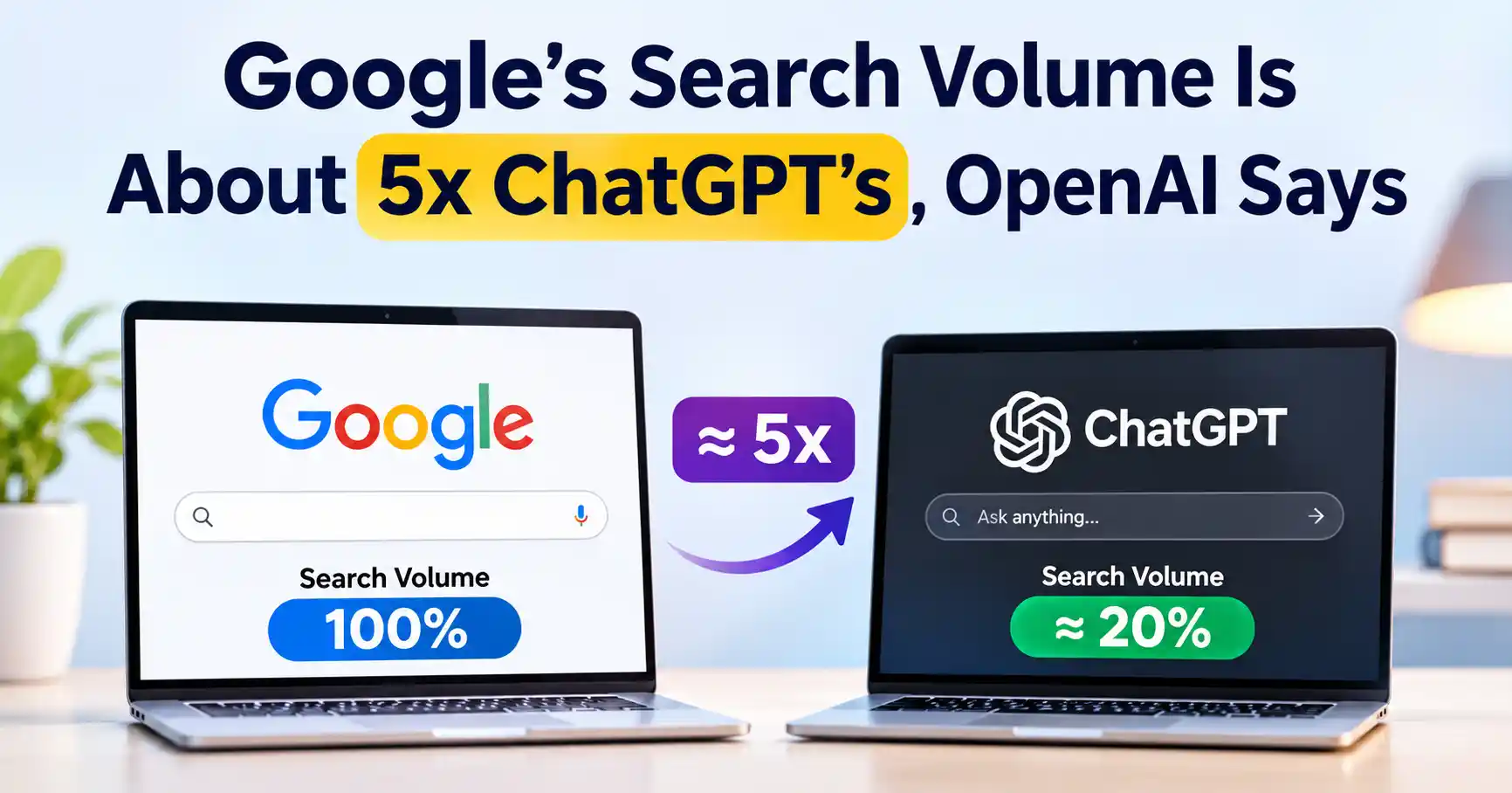
Google Search still handles far more search activity than ChatGPT. However, a recent statement from OpenAI suggests that its AI powered search experience has become a significant alternative for people looking for information online.
According to OpenAI consumer product lead Adam Fry, ChatGPT now processes search like queries equivalent to approximately 20% of Google’s search volume. In other words, Google handles roughly five times as many searches as ChatGPT, based on OpenAI’s comparison.
The announcement offers a useful snapshot of changing information discovery habits. For bloggers, marketers, and business owners, it also raises an important question: Should businesses continue investing in traditional SEO, or is AI search visibility becoming equally important?
The answer isn’t as simple as choosing one platform over the other.
What Did OpenAI Say About Google vs ChatGPT Search Volume?
On November 3, 2026, Big Technology published an interview with Adam Fry, OpenAI’s consumer product lead for ChatGPT. During the conversation, Fry said ChatGPT’s search like query volume had reached approximately one fifth of Google’s query volume.
The comparison can be summarized as follows:
| Platform | Reported relative search volume |
| Google Search | 100% |
| ChatGPT | Approximately 20% |
These figures represent the relative volume in OpenAI’s comparison, not the platforms’ share of the entire search market.
That distinction matters. OpenAI hasn’t published a complete breakdown of its calculation or identified the exact Google dataset used for comparison.
Still, the announcement suggests ChatGPT has become a meaningful destination for information searches, extending beyond its popularity for writing assistance and coding.
How Does OpenAI Count ChatGPT Searches?
One important detail in the announcement is how OpenAI defines a search.
Fry explained that a search is counted whenever a user’s question triggers a web search. Each individual question that results in a web search is counted separately.
Every Web Search Can Count as a Separate Query
Consider someone planning a trip to Hyderabad.
They might ask ChatGPT:
- What are the best hotels near Charminar?
- Which hotels offer family friendly rooms?
- What are the current prices?
- Which attractions are nearby?
If each question triggers a web search, every search can count separately.
This is different from counting conversations or individual users. A single person can generate multiple searches during one session.
Why the Comparison Isn’t Perfectly Apples to Apples
Google and ChatGPT aren’t identical search products.
Google primarily presents search results, links, shopping listings, maps, and other information through its search interface. ChatGPT combines conversational answers with web search capabilities.
A question answered using ChatGPT’s existing knowledge may not trigger a search. A follow up question requiring current information, however, might.
OpenAI’s definition therefore measures search like activity within ChatGPT rather than every prompt submitted to the platform.
The company also hasn’t fully explained how its Google comparison accounts for differences in search behavior, counting methods, or Google’s search features.
For that reason, the five times comparison should be treated as an estimate reported by OpenAI, rather than a universally standardized measurement.
Google vs ChatGPT Search Volume: What the Numbers Really Mean
Search volume provides useful context, but it doesn’t tell the complete story of how people discover information.
OpenAI’s comparison focuses on search like queries. It doesn’t establish that ChatGPT has captured 20% of Google’s search market share or that Google has lost that proportion of its users.
Three metrics are particularly important:
| Metric | What it measures |
| Search volume | Number of search queries processed |
| Search market share | A platform’s share of searches within a defined market |
| Referral traffic | Visitors sent from a platform to another website |
These metrics answer different questions.
Someone researching a laptop might ask ChatGPT five questions. That could generate several searches but result in just one website visit or none at all.
A Google user researching the same laptop might visit three review websites, browse a retailer, and return to Google to compare prices.
More search activity doesn’t automatically translate into more website traffic, customers, or commercial value.
An Earlier Independent Estimate Offers Additional Context
In February 2026, Ahrefs estimated that ChatGPT’s search like activity represented approximately 12% of Google’s search volume. The company used its own classification of ChatGPT prompts, making its methodology different from OpenAI’s later comparison.
The difference between the estimates highlights why search definitions matter.
Neither figure should be interpreted as an exact measurement of how many people have switched from Google to ChatGPT.
Why Is ChatGPT Search Growing?
One possible explanation is that people are increasingly using AI assistants for tasks that previously required several separate searches.
Conversational Search Makes Research Easier
Traditional search often involves formulating multiple queries, opening different pages, and comparing information manually.
ChatGPT allows users to ask follow up questions while maintaining the context of an earlier conversation.
For example, a business owner researching email marketing software might ask:
- Which email marketing platforms are suitable for small businesses?
- What features should I compare?
- Which platforms support automation?
- What are the main pricing differences?
Instead of starting a new search for every question, the user can continue the same conversation.
That doesn’t mean every answer is accurate or that AI always provides better information. It simply changes how people approach research.
People Are Using AI for More Than Writing and Coding
OpenAI’s Adam Fry described a shift toward searches involving people, places, products, finance, health, and other subjects that require current information.
When a question needs up to date facts, ChatGPT may perform a web search to retrieve relevant information. That creates more opportunities for search like usage.
For businesses, this introduces another potential discovery channel. Customers may ask AI assistants for product recommendations, comparisons, or explanations before visiting a company’s website.
The opportunity isn’t simply to publish more content. It’s to provide information that helps people evaluate options and make decisions.
Does ChatGPT’s Growth Threaten Google’s Search Dominance?
ChatGPT’s growth deserves attention, but Google’s position remains substantial.
Google operates a broad search ecosystem covering traditional results, shopping, maps, local listings, news, and AI powered search features.
During its October 2026 earnings discussion, Alphabet CEO Sundar Pichai said Google’s year over year search query growth rate was the highest it had been in five years, attributing part of that growth to AI investments.
This provides an important counterpoint to the idea that AI assistants are simply taking searches away from Google.
Google is also integrating AI into its own search experience. Users don’t necessarily have to leave Google to access conversational or AI assisted information discovery.
Search Volume Doesn’t Equal Website Traffic
This distinction is particularly important for publishers.
iTechManthra’s existing analysis of ChatGPT referral traffic highlights the difference between AI search activity and actual website visits.
ChatGPT Sends Less Than 1% of Google’s Traffic: What the Data Reveals
The article discusses reported GA4 findings in which ChatGPT generated considerably fewer sessions than Google organic search across the analyzed websites.
AI assistants can provide answers directly within their interfaces. A user might receive a useful summary without clicking any source.
For publishers, appearing in an AI response and generating a website visit are two different outcomes. Both can matter, but they should be measured separately.
What Does This Mean for SEO and Digital Marketing?
The biggest takeaway for marketers is that Google SEO and AI search visibility should complement each other rather than compete for the same budget automatically.
Businesses still need search traffic, but they also need to understand how customers discover brands through AI assistants.
Don’t Abandon Google SEO
Google continues to provide opportunities for businesses to attract visitors through informational, commercial, and transactional searches.
For example, a SaaS company can target queries such as:
- Best CRM software for startups
- CRM pricing comparison
- How to automate sales follow ups
- CRM implementation checklist
These searches can attract people at different stages of the buying journey.
Google’s guidance on AI features in Search also confirms that established SEO practices remain relevant for AI features such as AI Overviews and AI Mode. There are no additional technical requirements or special AI optimization techniques needed for eligibility.
Build Visibility in AI Search
Businesses can improve their chances of becoming useful sources for AI assisted research by publishing original, well supported content.
Practical steps include:
- Explain products and services clearly.
- Publish original research, useful comparisons, and detailed guides.
- Support factual claims with credible sources.
- Make important information accessible in text.
- Maintain clear internal links between related pages.
- Keep product specifications, pricing, and business information accurate.
Google’s guidance on generative AI search emphasizes unique, helpful, and reliable content rather than generic information that can be easily reproduced.
For additional context, iTechManthra has also explored the broader search volume landscape:
AI Assistants Global Search Volume Study: Are AI Tools Really Replacing Search Engines?
This provides another perspective on how AI assistants are changing information discovery.
Measure Search and AI Traffic Separately
Marketers shouldn’t judge SEO performance using a single traffic metric.
A practical measurement setup includes:
| Tool | What to monitor |
| Google Search Console | Organic impressions, clicks, CTR, and rankings |
| Google Analytics 4 | Organic sessions, engagement, and conversions |
| GA4 referral reports | Visitors arriving from AI platforms |
| CRM or sales analytics | Qualified leads and revenue by acquisition channel |
For example, a content page might generate 10,000 Google organic visits and 100 AI referrals during a reporting period.
Although AI referrals are fewer, the company should investigate whether those visitors engage with product pages or convert into leads.
The goal is to understand channel performance, not assume every AI referral is valuable or that every Google visitor converts.
FAQ’s
According to OpenAI consumer product lead Adam Fry, ChatGPT’s search like query volume is approximately 20% of Google’s. This suggests Google processes around five times as many searches, based on OpenAI’s reported comparison. The methodology hasn’t been fully disclosed.
Not necessarily. ChatGPT is becoming an alternative for certain information discovery tasks, but Google’s search ecosystem remains considerably larger. Google’s own search query growth also indicates that traditional search continues to evolve alongside AI.
No. Search volume measures queries, while referral traffic measures visitors sent to websites. ChatGPT can answer questions directly without users clicking external links, so its search activity doesn’t automatically translate into equivalent website traffic.
Businesses should prioritize channels that deliver measurable value while building visibility across relevant discovery platforms. Strong technical SEO, original content, accurate information, and useful resources can support both traditional search and AI assisted discovery.
Conclusion
OpenAI’s latest comparison puts ChatGPT’s search like query volume at approximately one fifth of Google’s. That’s a meaningful development for a platform that initially became popular for writing, coding, and conversational assistance.
However, the announcement doesn’t prove that Google is losing its dominance or that ChatGPT has captured one fifth of Google’s search market share.
For bloggers, content creators, marketers, and business owners, the practical lesson is to focus on visibility and business outcomes.
Continue investing in Google SEO, create content that genuinely helps readers, and monitor how AI assistants contribute to discovery, referrals, and conversions.
The search landscape is expanding, but useful content and trustworthy information remain important.

Kumar Swamy is the CEO of Itech Manthra Pvt Ltd and a dedicated Article Writer and SEO Specialist. With a wealth of experience in crafting high-quality content, he focuses on technology, business, and current events, ensuring that readers receive timely and relevant insights.
As a technical SEO expert, Kumar Swamy employs effective strategies to optimize websites for search engines, boosting visibility and performance. Passionate about sharing knowledge, he aims to empower audiences with informative and engaging articles.
Connect with Kumar Swamy to explore the evolving landscape of content creation!