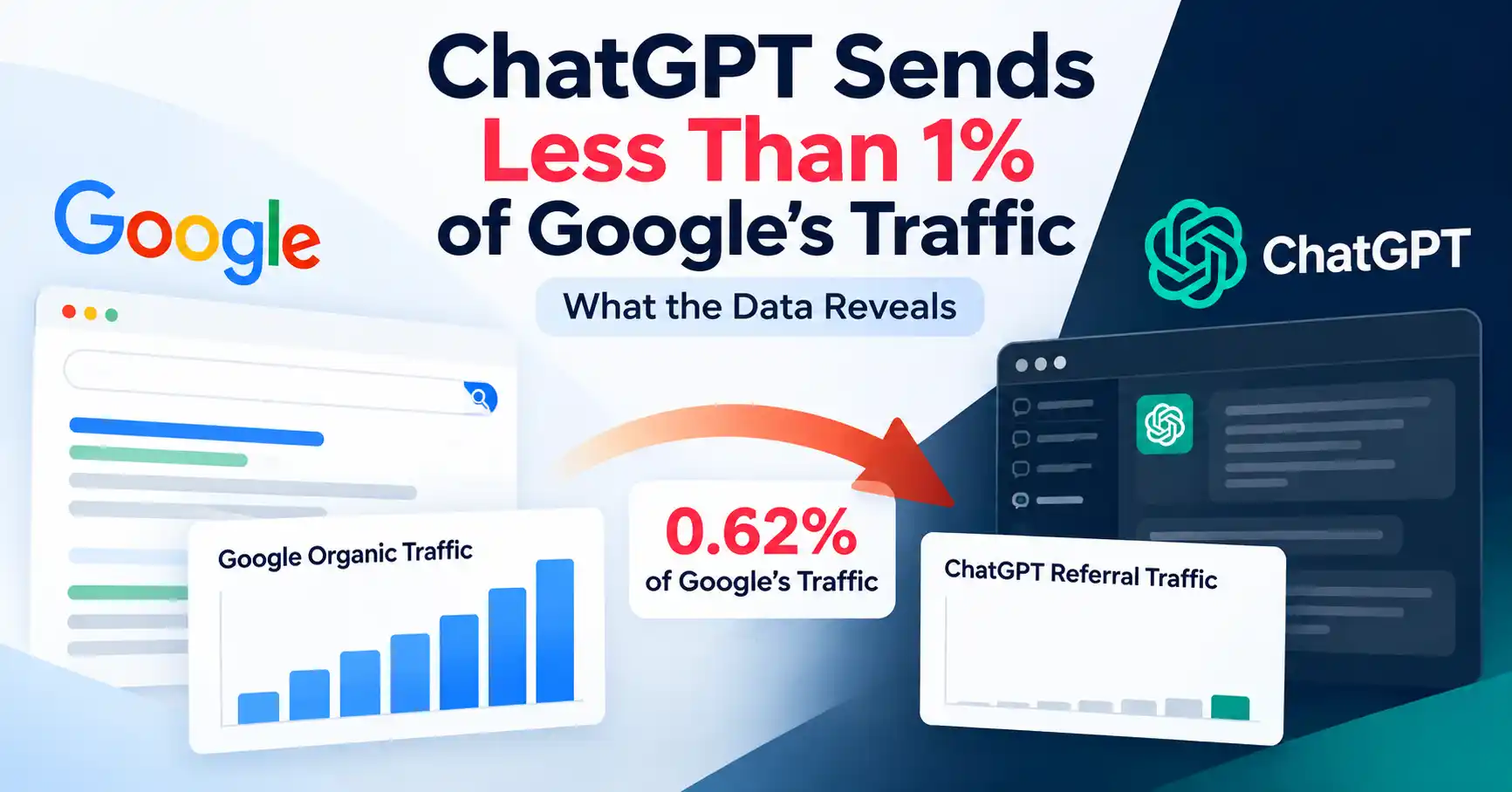
ChatGPT is changing how people find information, research products, and explore new ideas online. Yet when it comes to bringing visitors to websites, Google Search remains far ahead.
An analysis of Google Analytics 4 (GA4) data from 100 websites found that ChatGPT generated just 0.62% as many sessions as Google organic search. Combined, referrals from multiple large language models (LLMs) amounted to 0.73% of Google organic sessions in the sample. Search Engine Land reported the findings in October 2026.
For bloggers, content creators, and businesses, the numbers raise a practical question: is it still worth prioritizing traditional SEO, or should more resources go toward AI search optimization?
The answer isn’t an either or decision. Google remains a major source of website traffic, while AI referrals may offer a different kind of opportunity. Understanding how the two channels differ can help marketers decide where to focus their efforts.
What Does the Latest ChatGPT Traffic Data Show?
SEO consultant Marie Haynes analyzed 12 months of GA4 data across 100 websites, covering more than 145 million sessions. The research compared traffic attributed to ChatGPT and other LLMs with traffic from Google organic search.
Here’s a breakdown of the reported findings:
| Metric | Reported finding |
| ChatGPT sessions relative to Google organic sessions | 0.62% |
| All LLM sessions relative to Google organic sessions | 0.73% |
| ChatGPT visitor conversion rate | 13.8% |
| Google organic visitor conversion rate | 3.02% |
| Websites in the main analysis | 100 |
| Total sessions analyzed | More than 145 million |
The conversion figures came from a smaller group of 55 websites that tracked conversions. These results describe the analyzed sample, so they shouldn’t be treated as standard conversion benchmarks for every industry.
For additional context, read Marie Haynes’ original analysis.
What Do the 0.62% and 0.73% Figures Actually Mean?
These percentages compare AI referral sessions with Google organic sessions. They don’t mean ChatGPT accounts for just 0.62% of a website’s total traffic, nor do they capture every instance in which AI influences a visitor.
For example, suppose a website receives 100,000 Google organic sessions during a reporting period. If ChatGPT sends 620 sessions over the same period, its referral volume equals 0.62% of Google’s.
The distinction is important. Without understanding what the percentage measures, it’s easy to draw the wrong conclusions from traffic comparisons.
The analysis also found that ChatGPT referral growth slowed after a period of rapid expansion. However, a trend within this sample doesn’t necessarily predict how AI adoption will develop across the wider web.
Why Does Google Still Send More Website Traffic Than ChatGPT?
Google and ChatGPT overlap in some areas, but people use them differently.
Google presents links that users can explore, compare, and revisit. Someone researching a product might visit several review sites, compare prices, and read detailed buying guides before making a decision.
ChatGPT often provides a synthesized answer directly in the conversation. Users can get useful information without clicking through to another website.
That difference helps explain why the two platforms can have very different referral volumes.
AI Answers Don’t Always Lead to Website Visits
Consider someone comparing project management software. A Google search might lead them to product reviews, comparison articles, pricing pages, and vendor websites.
ChatGPT could summarize the main differences in a single response. The user might click a recommended source, but they could also finish their research without visiting any of those websites.
This highlights the difference between AI visibility and referral traffic. A brand may appear in an AI generated answer without generating a measurable website session.
Google’s own AI search experiences add another layer to the picture. Someone might discover a brand through an AI assisted result but visit its website later through a different channel. That journey won’t necessarily appear in analytics as an AI referral.
What This Means for SEO
Google organic traffic remains valuable because it can bring visitors to pages designed to answer questions, generate leads, or drive sales.
That doesn’t make AI visibility irrelevant. It means marketers need to measure the channels separately rather than assume that more AI mentions will automatically produce more website visits.
Semrush’s ChatGPT traffic analysis offers additional context on referral patterns and how users move from AI platforms to websites.
ChatGPT Visitors Convert at a Higher Rate, but Is That Enough?
One finding stands out: ChatGPT visitors had a reported conversion rate of 13.8%, compared with 3.02% for Google organic visitors among the 55 websites tracking conversions.
At first glance, this suggests that ChatGPT traffic could be more effective at generating conversions per visit. But conversion rates tell only part of the story.
Why Conversion Rate and Total Conversions Matter
Conversion rate measures the proportion of visitors who complete a desired action, such as submitting a lead form, starting a free trial, or making a purchase.
A channel can convert a higher percentage of visitors and still generate fewer conversions overall if it sends substantially less traffic.
The original analysis reported that Google organic generated 27 times as many conversions as all LLMs combined. This is why businesses need to look at both traffic volume and conversion efficiency.
Consider a hypothetical SaaS company. ChatGPT might send a small number of highly relevant visitors to its pricing page, some of whom sign up for a trial. Google could bring a much larger audience across informational articles, comparison pages, and product related searches.
Both channels can contribute to growth, but their roles may differ.
Don’t Assume Every AI Visitor Is More Valuable
The reported conversion gap is worth investigating, but it shouldn’t be applied blindly to your own website. Industry differences, conversion definitions, attribution settings, and sample size can all affect the results.
To understand which channels contribute most to your business, track:
- Qualified leads: Which visitors become genuine sales opportunities?
- Revenue: Which channels contribute to purchases or closed deals?
- Landing pages: Are AI referrals reaching relevant, useful pages?
- Engagement: Do visitors explore your products or return later?
- Attribution: Are conversions measured consistently across channels?
For more context, read iTechManthra’s article on how ChatGPT and Google referral conversions compare.
What Should Bloggers and Businesses Do About These Findings?
The data doesn’t suggest abandoning SEO or ignoring AI search. Instead, use it to decide where your time and marketing budget are likely to make the greatest difference.
1. Protect Your Existing Google Organic Traffic
Start with the pages that already bring visitors to your website. Use Google Search Console to review your leading queries, pages, impressions, clicks, and click through rates.
Look for pages that attract relevant search traffic but aren’t performing as well as expected. Updating outdated information, improving internal links, answering the main question earlier, and making the next step clearer can help improve the user experience.
Google’s SEO Starter Guide provides a useful foundation for creating accessible content that search engines can understand.
2. Measure AI Referral Traffic in GA4
Rather than guessing how much traffic AI platforms generate, examine your own analytics.
In GA4, open Reports → Acquisition → Traffic acquisition and review the session source/medium dimension. Look for identifiable AI referral sources, such as chatgpt.com, and compare their sessions, engagement, and conversions with Google organic traffic.
Keep in mind that attribution isn’t perfect. Some AI influenced visits may appear as direct traffic or be credited to another channel. Compare consistent reporting periods and use the same conversion definitions across channels.
For practical guidance, see iTechManthra’s article on tracking ChatGPT referral traffic in GA4.
3. Test AI Visibility Without Abandoning SEO Fundamentals
Create content that answers your audience’s questions directly, explains complex topics clearly, and supports important claims with reliable sources.
For example, a cybersecurity company could publish a detailed comparison of security standards, a practical implementation checklist, and an explanation of common compliance mistakes. Such content can serve readers arriving through traditional search while also helping people researching these topics with AI tools.
Google’s guidance on creating helpful, reliable, people first content is a sensible starting point. There’s no need to create a separate page for every AI platform or invest in optimization tactics that lack evidence.
Does This Mean AI Search Optimization Is Overhyped?
Not necessarily. The findings show that AI referral traffic was small compared with Google organic traffic in this particular sample. They don’t prove that AI search has little business value or that its influence will remain limited.
Referral sessions capture visits that analytics can attribute to a source. They don’t fully measure brand exposure, assisted conversions, or visitors who discover a company through AI and return later.
Businesses should avoid two extremes: treating AI search as a replacement for SEO before the results justify it, or dismissing AI visibility simply because referral volumes are lower.
A more practical approach is to maintain effective SEO, track AI referrals separately, and invest further when the results support it.
FAQ’s
The 100 site analysis found that ChatGPT generated sessions equivalent to 0.62% of Google organic sessions. This is a relative comparison, not ChatGPT’s share of total website traffic.
Google generated considerably more total traffic in the study. However, ChatGPT visitors had a higher reported conversion rate in the smaller conversion tracking sample. The more valuable channel for your business depends on qualified leads, revenue, and other measurable outcomes.
Prioritize SEO that already delivers measurable results while testing AI visibility where it makes sense for your audience. Generative engine optimization (GEO) can complement traditional SEO, but businesses should measure its contribution rather than assume it will deliver more traffic or sales.
Open the Traffic acquisition report and examine session source/medium. Identify ChatGPT referrals, compare them with Google organic, and review conversions and landing pages over consistent reporting periods. Remember that some AI influenced visits may not be attributed to ChatGPT.
Conclusion
ChatGPT’s referral traffic remains small compared with Google organic traffic in the reported study. Still, the higher conversion rate observed among ChatGPT visitors is a reminder that traffic volume isn’t the only metric worth watching.
For bloggers, marketers, and business owners, the next steps are straightforward: protect your organic search performance, measure AI referrals, and evaluate each channel based on business outcomes.
AI search may change how people discover brands, but effective marketing still comes down to understanding your audience and publishing content that genuinely helps them.

Kumar Swamy is the CEO of Itech Manthra Pvt Ltd and a dedicated Article Writer and SEO Specialist. With a wealth of experience in crafting high-quality content, he focuses on technology, business, and current events, ensuring that readers receive timely and relevant insights.
As a technical SEO expert, Kumar Swamy employs effective strategies to optimize websites for search engines, boosting visibility and performance. Passionate about sharing knowledge, he aims to empower audiences with informative and engaging articles.
Connect with Kumar Swamy to explore the evolving landscape of content creation!