Have you tried to figure out if your site is being used by AI search systems, even if you never see the final answer on screen?
It is getting easier to check that in China.
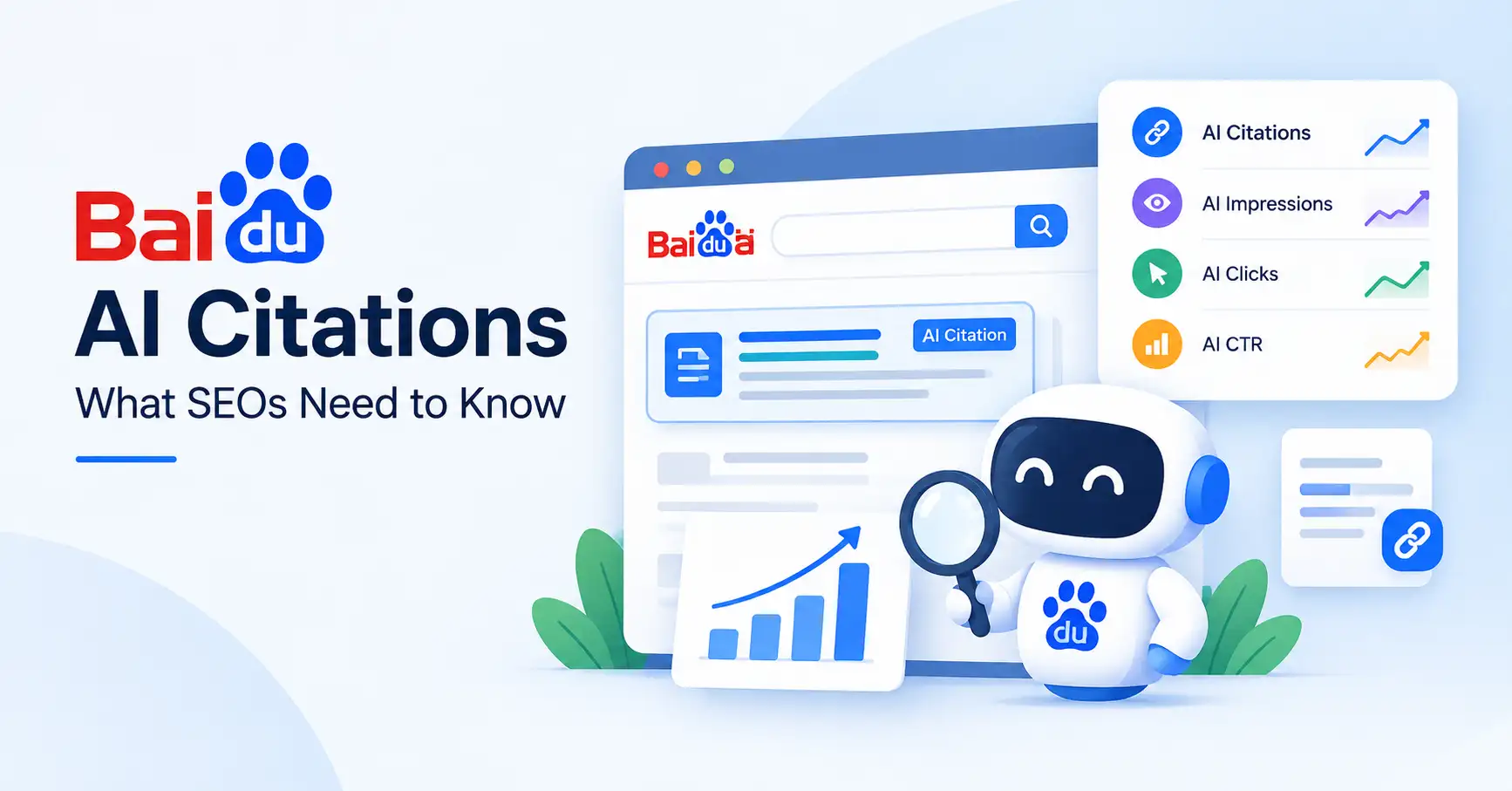
Baidu added a new section in its webmaster tools called AI Traffic Analysis. Website owners can use it to see how their pages show up in AI style results. The report lists AI citations, AI impressions, AI clicks, and AI CTR.
There is a limit, though. The feature is still being rolled out. As a result, many site dashboards may show no data right now.
This matters for SEOs because AI search reach has often been hard to track. At the same time, you should be careful with a brand new number. It is easy to read too much into it.
So, what do Baidu AI citations mean in practice, and what should you not treat them as?
What are Baidu AI citations, and why do they matter?
Baidu AI citations show how many times a site is mentioned in an AI answer shown in Baidu’s usual search results.
This is not the same as a regular organic ranking.
A traditional search result tells you that your page appeared for a query. An AI citation tells you that Baidu’s AI system used your content as a source while constructing an answer.
The new reporting system is built around four main measurements:
- AI Citations: How often your pages are cited in AI answers.
- AI Impressions: How often users see a link to a cited page.
- AI Clicks: How often users click that cited link.
- AI CTR: Baidu calculates this using clicks divided by citations.
That last point deserves attention because it isn’t the same calculation many SEOs are used to seeing in traditional search reporting.
And that difference can change how you interpret the numbers.
How does Baidu measure AI search visibility?
This is where the new dashboard gets particularly interesting.
In ordinary SEO reporting, CTR is generally discussed in relation to impressions. Baidu’s AI CTR, however, is based on AI clicks divided by AI citations, while AI impressions are tracked separately.
Why does that matter?
Your page grabs countless citations. Still, users notice that exact link just four hundred times. Pitting total clicks straight against all those citations yields a wildly different picture than measuring against those visible impressions alone.
So don’t look at the AI CTR number in isolation.
Instead, watch the relationship between citations, impressions and clicks. Over time, that combination may provide a much clearer picture of whether AI generated answers are creating meaningful visibility for your website.
This is one of the most useful lessons from the launch: AI search metrics don’t necessarily behave like traditional SEO metrics.
Which Baidu AI data is most useful for SEO?
The headline metrics are interesting, but the keyword data could become the real goldmine for SEOs.
Baidu released a new report with tables of keywords and pages tied to AI citations. Each table can list as many as 50,000 items. The rows are arranged by clicks.
What does that really mean for you?
You may not just learn that your site got traffic from Baidu. In time, you could also find out which search queries led Baidu’s AI to point to your content.
That’s valuable information for AI search optimization.
For example, if a technology website discovers that its pages are repeatedly cited for questions around “best Android security apps,” that could reveal a content opportunity. The publisher could examine those pages, identify related questions, strengthen supporting content and build a more complete topic cluster.
The important part is not blindly copying the keywords.
It’s understanding why those queries produced citations in the first place.
As Search Engine Journal contributor Marcus Pentzek points out, the keyword information may be more actionable than simply watching the headline citation number.
Does getting more AI citations improve Baidu rankings?
This is where SEOs need to slow down a little.
There are already discussions suggesting that AI citations could somehow influence a website’s traditional Baidu ranking authority. But there is currently no clear evidence from Baidu’s announcement that receiving an AI citation directly increases conventional ranking signals.
Think of a citation as a visibility signal instead of a direct ranking factor. That distinction really matters. If Baidu pulls your article into an AI search result, your content made the cut as a source. That is genuinely useful data right there. But it doesn’t mean Baidu has announced a new formula where more citations equal better organic rankings.
The same principle applies beyond Baidu.
Google insists classic SEO still matters for AI search. Crawlability, proper indexing, robust content, smart internal links, and page experience remain utterly crucial. Seriously. Do not ditch your current strategy just because tracking AI citations is finally possible. Just keep nailing those foundational basics.
What does Baidu’s update mean for Generative Engine Optimization?
The bigger story may be the growing importance of Generative Engine Optimization (GEO).
Traditional SEO asks:
“How do I get my page to rank?”
AI search introduces another question:
“How do I make my content useful enough to be selected as a source?”
Those aren’t exactly the same thing.
AI systems need information they can discover, understand and use. That makes clear structure, concise answers, strong topical coverage and trustworthy information increasingly useful.
This is also why AI search visibility shouldn’t be measured only through clicks.
A page can influence an AI answer without generating a traditional website visit. The user might read the answer, remember the brand and move on.
Google has similarly emphasized that AI search can expose users to a wider range of supporting websites, while continuing to recommend foundational SEO practices rather than special AI only hacks.
For publishers, that means visibility itself is becoming another part of the search journey.
What should SEOs do with Baidu AI citation data?
There’s no need to completely reinvent your SEO strategy overnight.
Start with the basics.
First, make sure your website is verified in Baidu’s webmaster platform so you’re ready when the reporting becomes available for your property.
Second, establish a baseline. Don’t obsess over the first number you see. Early data will be much more useful for identifying trends than declaring a universal benchmark.
Third, study the keywords behind your citations. Look for repeated topics, questions and content gaps.
Fourth, compare AI visibility with normal organic performance. A page that performs well in both areas may reveal useful patterns about search intent and content quality.
Finally, remember that Baidu isn’t the entire Chinese AI search market. Its reporting doesn’t automatically represent standalone AI products or rival platforms such as Doubao, DeepSeek, Qwen/Quark and Kimi.
That’s why a broader Baidu SEO strategy should still consider the wider search ecosystem.
For a practical look at the technical side, see our guide to technical SEO for AI search, especially if your content is struggling to get discovered or indexed.
You can also explore our guide to Google’s AI optimization approach to see how the principles of AI search visibility are evolving outside Baidu.
For broader guidance on Google’s current approach to generative search, its official documentation is also useful: Google’s guide to optimizing for generative AI search
What shouldn’t SEOs read into Baidu AI citations?
Probably the biggest mistake would be treating one new metric as the new definition of SEO success.
AI citations don’t automatically mean higher rankings. They don’t prove that your content will be cited by every AI platform. And they don’t tell you exactly how users perceive your brand after seeing an AI generated answer.
What they do provide is something SEOs have wanted for years: more first party visibility into how AI search uses website content.
That’s valuable.
But the smartest way to use the data is as evidence, not as a magic ranking formula.
FAQ’s
They measure how often a website’s pages are cited as sources in AI generated answers within Baidu’s traditional search experience.
Baidu defines AI CTR as AI clicks divided by AI citations, rather than the more familiar clicks divided by impressions.
Baidu’s current reporting announcement does not establish AI citations as a direct traditional ranking factor. Treat citations as an AI visibility metric unless Baidu provides further evidence.
They can show which search queries are leading to AI citations of your content, giving SEOs useful information for content planning and optimization.
No. The reported data is limited to AI answers within Baidu’s traditional search scenario and doesn’t represent the wider ecosystem of independent AI platforms.
Conclusion
Baidu’s move to measure AI citations is more than another dashboard updateAI visibility is finally measurable, moving past guesswork, Forget chasing raw citation counts blindly. Instead, use that data to uncover what queries your content resolves, which specific pages search engines favor, and where your current approach falls flat. It is time to get real results.That’s a much healthier way to approach AI search optimization.
And as the data starts becoming available, the most interesting question won’t simply be “How many times was I cited?”
It’ll be “Why was I cited, and what can I learn from it?”

Kumar Swamy is the CEO of Itech Manthra Pvt Ltd and a dedicated Article Writer and SEO Specialist. With a wealth of experience in crafting high-quality content, he focuses on technology, business, and current events, ensuring that readers receive timely and relevant insights.
As a technical SEO expert, Kumar Swamy employs effective strategies to optimize websites for search engines, boosting visibility and performance. Passionate about sharing knowledge, he aims to empower audiences with informative and engaging articles.
Connect with Kumar Swamy to explore the evolving landscape of content creation!