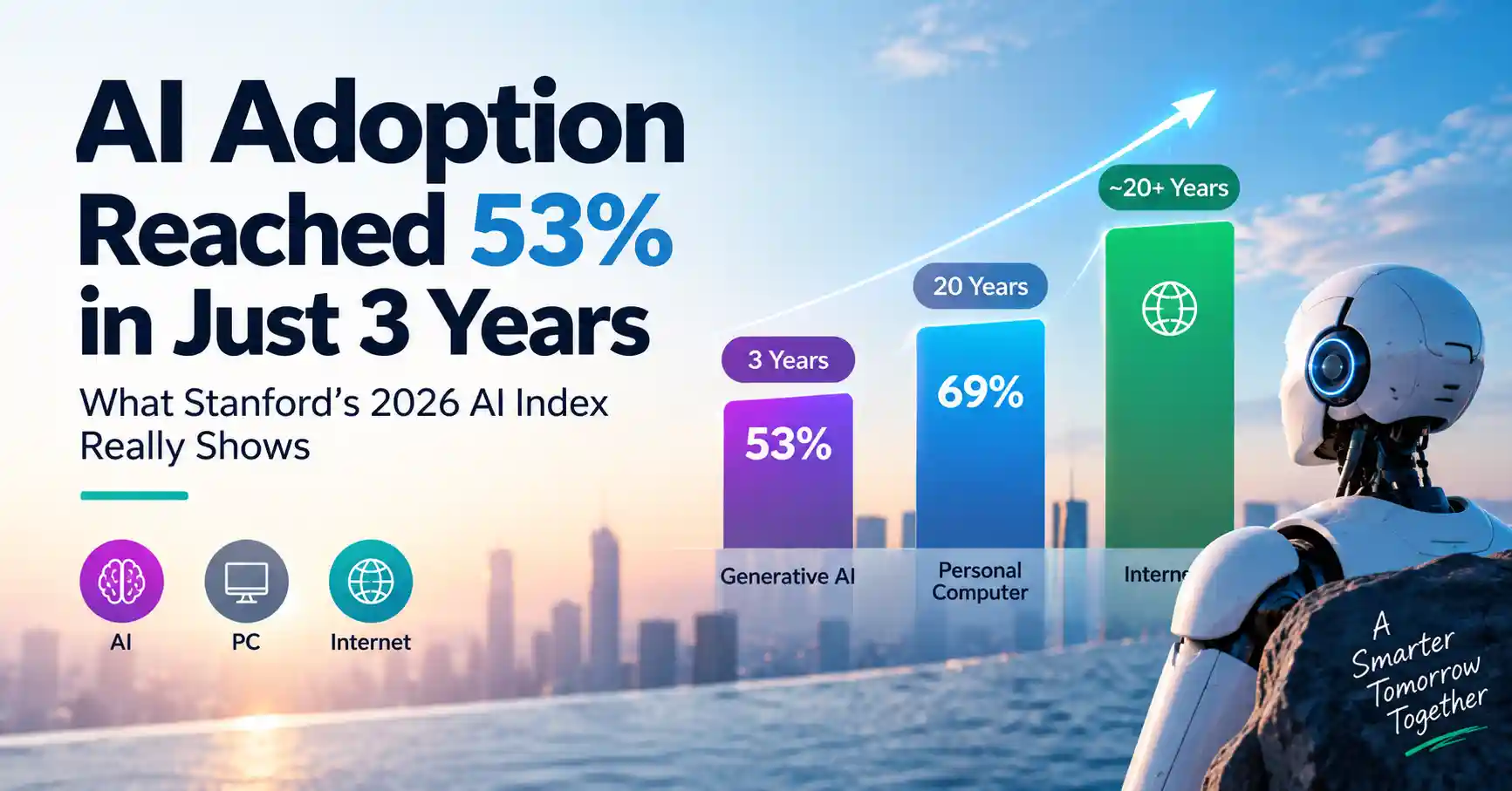
It’s wild how fast AI went from a weird experiment to just… normal, right? Like, just a few years back, getting ChatGPT to churn out an email or boil down a report felt like a neat trick. Now, this generative AI stuff is everywhere, search engines, all sorts of software, schools, marketing departments, customer support, writing code, you name it. It’s just part of the daily grind. Stanford’s 2026 AI Index Report really drives this home with a number you can’t brush off: generative AI hit about 53% adoption in three years. That’s faster than PCs or the internet ever took off at the same point in their lives.
But the headline doesn’t tell the whole story.
The more interesting question is why AI adoption has happened so quickly, whether the comparison with PCs and the internet is really like for like, and what these AI adoption statistics mean for businesses and marketers.
What does Stanford’s AI adoption data actually show?
The 2026 AI Index from Stanford just came out, charting generative AI’s explosive spread. It even stacked it up against tech juggernauts, PCs, and the internet. Get this: generative AI hit roughly 53% adoption in just three years. That’s since ChatGPT, its first big splash, went public in 2022.
For comparison, the report’s historical data shows the personal computer and internet followed much slower adoption curves.The chart shows computer use at about 69% after around 20 years. Internet use climbed to a higher level, but it took longer than that.
In short, these AI adoption numbers point to the same general pattern. AI didn’t simply grow quickly. It reached mainstream usage unusually fast.
And there’s another number worth watching. Stanford says 88% of surveyed organizations reported using AI in 2025, while 70% reported using generative AI in at least one business function.
So this isn’t only a consumer story. AI adoption is becoming an organizational story too.
For readers who want a broader explanation of the technology itself, our AI Overview: Artificial Intelligence provides useful background on how AI works and where it’s being applied.
Why is generative AI adoption happening faster than PCs and the internet?
This is where the comparison gets interesting.
Buying a personal computer once meant making a significant hardware purchase. Getting online also required equipment, an internet connection and, in many cases, a technical setup that wasn’t exactly beginner friendly.
Generative AI has a very different distribution model.
Most people already own a smartphone or computer capable of accessing AI tools. They don’t need to buy a new device just to try ChatGPT, Gemini or another AI assistant. Many services also offer free access.
In other words, AI arrived on top of infrastructure people already had.
That’s a huge advantage.
A new technology that requires consumers to buy new hardware naturally faces friction. A technology that can appear inside an existing search engine, office suite, smartphone or browser can spread much faster.
This helps explain the unusually high AI adoption rate reported by Stanford.
There’s also the simplicity factor. A person doesn’t need to understand machine learning, neural networks or large language models to use generative AI. They can simply type a question.
That lowered barrier to entry has probably played a major role in accelerating adoption.
Is the 53% AI adoption rate really comparable to the PC and internet?
Here’s where some caution is necessary.
The 53% figure is impressive, but it shouldn’t be interpreted as meaning that AI has completely replaced the PC or internet in importance.
The technologies are being measured in different eras, with different products, infrastructure and definitions of usage.
Stanford’s comparison measures usage rates against the early adoption trajectories of earlier technologies.The report says the generative AI numbers come from broad user estimates. It also uses older records from other studies, which use separate data sets.
You can compare it to two different things. One is buying a computer. The other is trying an AI chatbot.
Buying a PC represents a substantial commitment. Someone who purchases one is likely to keep using it for years.
Trying an AI tool can take less than a minute.
So the adoption curves are useful for understanding speed, but they shouldn’t automatically be treated as identical measures of technological dependence.
That’s an important distinction that gets lost when the 53% headline is repeated without context.
What do the latest AI adoption statistics mean for businesses?
For businesses, the bigger story isn’t simply that more people are using AI.
It’s that AI is becoming part of normal workflows.
Stanford reports that 70% of surveyed organizations were using generative AI in at least one business function in 2025. At the same time, AI agent deployment remained in the single digits across nearly all business functions.
That tells us something useful.
There’s a difference between using AI and rebuilding a workflow around AI.
A marketing team asking an AI assistant to create a first draft is using AI.
A company redesigning its research, content production, customer support and reporting processes around AI is doing something deeper.
That’s likely to become one of the biggest AI trends 2026 has to offer: moving from experimentation toward integration.
Businesses don’t necessarily need to replace entire teams with AI. Often, the best path is to cut the same tasks over and over, and give staff tools that work better.
Examples include research, summaries, replies for customer support, work with numbers, help with code, and coming up with content ideas.
The talk is shifting, too. It used to be “Do we want AI?” Now it is more like, “Which steps benefit from AI in our day to day work?”
Does faster AI adoption mean AI is already delivering huge productivity gains?
Not necessarily.
This is probably the most important part of the Stanford data to understand.
Adoption can happen much faster than measurable economic transformation.
A company might give employees access to an AI assistant, but that doesn’t automatically mean productivity will increase. Employees may need training. Existing workflows may need to change. Data may need to be cleaned up. Security and governance policies may need to be established.
There’s also the simple problem of knowing what to automate.
Recent analysis of the AI economy shows that AI use is expanding rapidly, while productivity effects are appearing unevenly.
Stanford similarly reports that AI’s labor market effects are uneven and that expected workforce reductions are concentrated in certain functions rather than appearing as broad economy wide job losses.
So the lesson for AI in business isn’t “adopt AI as quickly as possible.”
It’s to identify valuable use cases and measure whether they actually improve the work.
What should marketers and SEO professionals learn from the AI adoption boom?
Marketers should pay close attention to this move. AI is not just rewriting content.
It is also changing how people look for answers.
Now someone can ask an AI tool to explain a topic, list pros and cons, suggest options, or summarize research before they open a normal search result.
Because of that, showing up in AI responses is starting to matter as much as classic SEO.
This does not mean Google suddenly stops being important.
Instead, the process of finding information now involves more than one path.
Search sites, AI helpers, and chat style interfaces all affect what people see first.
That is why SEO teams need to understand how teams are adopting AI.
The companies that adapt aren’t necessarily the ones publishing the most AI generated content. They’re the ones creating useful, original information that can be understood, trusted and referenced across different discovery systems.
For example, our coverage of Google Search Console AI Performance Reports looks at how AI search visibility is becoming more measurable for website owners.
What is the biggest lesson from Stanford’s AI adoption data?
The biggest lesson isn’t simply that AI is “faster than the internet.”
It’s that the barrier between experimenting with AI and mainstream adoption has become incredibly small.
Stanford estimates that generative AI reached 53% population adoption within three years. The report also estimates that U.S. consumer surplus from generative AI reached $172 billion annually by early 2026, up from $112 billion a year earlier.
That combination of rapid adoption and growing consumer value is significant.
At the same time, adoption varies considerably by country. Stanford reports adoption rates of 61% in Singapore and 64% in the UAE, while the United States ranked 24th at 28.3% in the cited measure.
So there isn’t one universal AI adoption story.
Different countries, industries and organizations are moving at different speeds.
That is likely the best way to read the report. Do not fixate on one headline number. Instead, check where people are actually adopting the tools. Also, see how much they are using them and for what tasks. Finally, ask if the use leads to clear results you can measure.
FAQ’S
Stanford’s 2026 AI Index estimates that generative AI reached approximately 53% population adoption within three years, faster than the early adoption trajectories of the personal computer and internet.
The exact rate depends on what is being measured. Stanford reports approximately 53% population level generative AI adoption within three years and 88% organizational AI adoption in its 2025 survey data.
AI tools can be accessed through devices people already own, often with free tiers. Unlike PCs, AI doesn’t require most users to purchase new hardware before trying it.
Yes. Stanford reports that 70% of surveyed organizations were using generative AI in at least one business function in 2025. However, deployment of AI agents remained relatively early.
Not automatically. Stanford’s data shows labor market effects are uneven, with changes concentrated in particular occupations and younger workers in exposed fields. Adoption, productivity and employment effects are related but aren’t the same thing.
Conclusion:
The Stanford 2026 AI Index makes one thing very clear: AI adoption has happened at a remarkable speed.
Generative AI adoption rocketed to 53% in just three years. That’s faster than PCs or the internet ever went. Businesses are all in a wild 88% used AI in 2025.
But speed isn’t the whole story.
The real hurdle now? Making this widespread access actually useful, we’ve got to move beyond random experiments and build solid, integrated workflows. It’s about shifting from just having AI tools to actually producing real, measurable business results.
The PC changed how people worked. The internet changed how information moved. AI may be changing how people interact with information itself.
The real question now isn’t how quickly AI can be adopted. It’s what people and businesses actually do with it once it’s everywhere.

Kumar Swamy is the CEO of Itech Manthra Pvt Ltd and a dedicated Article Writer and SEO Specialist. With a wealth of experience in crafting high-quality content, he focuses on technology, business, and current events, ensuring that readers receive timely and relevant insights.
As a technical SEO expert, Kumar Swamy employs effective strategies to optimize websites for search engines, boosting visibility and performance. Passionate about sharing knowledge, he aims to empower audiences with informative and engaging articles.
Connect with Kumar Swamy to explore the evolving landscape of content creation!