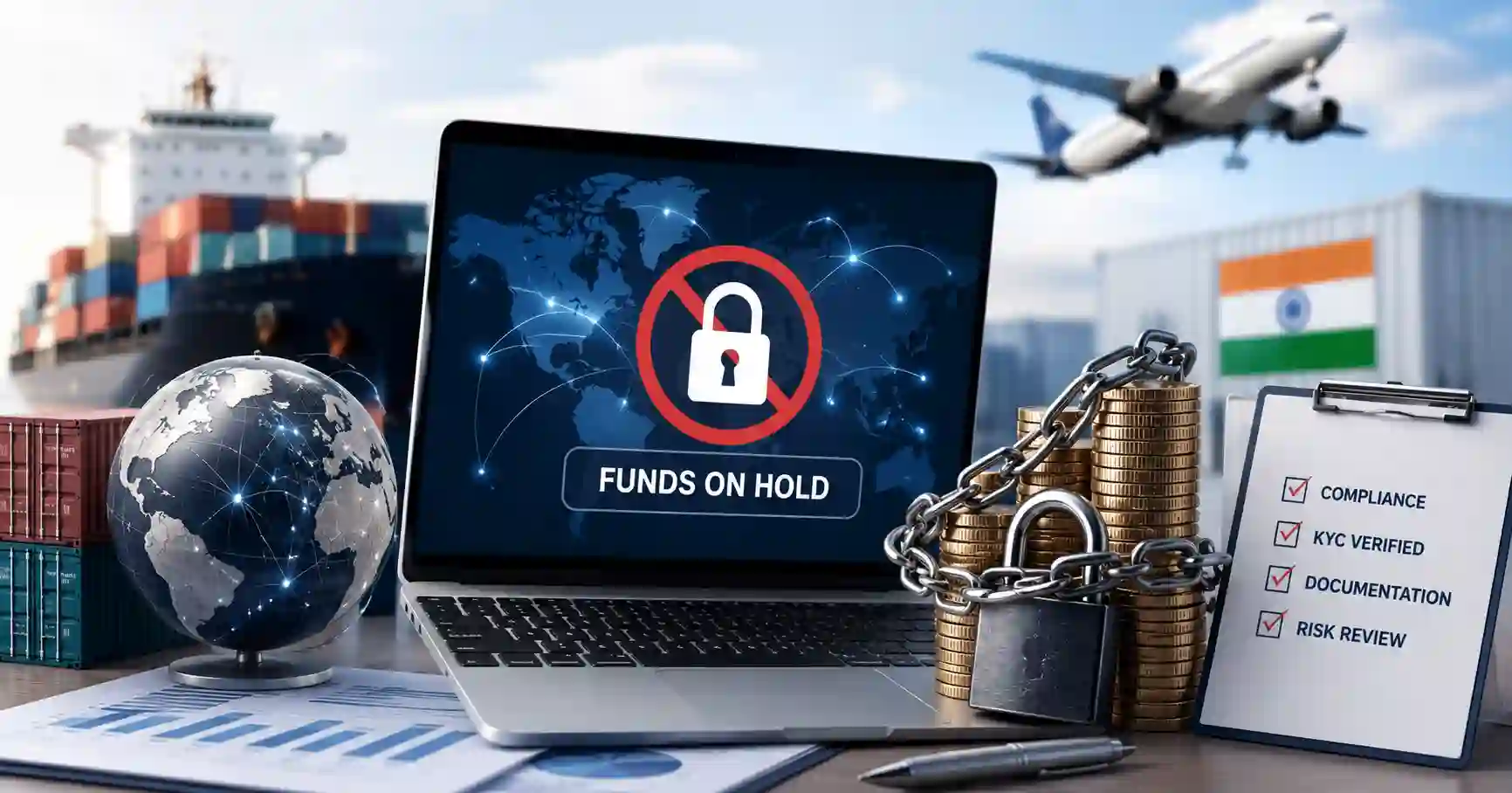
The failure mode nobody plans for is the one where the money arrives and then stops. Not a rejected payment, which is at least immediately visible, but a payment that has been received, is sitting somewhere, and cannot be accessed while somebody decides something.
For an Indian exporter this is worse than an expensive transfer, because it is unbudgeted and it is unpredictable. A business can absorb paying one percent more than it should. It struggles to absorb forty lakh being unavailable for six weeks in a quarter where payroll does not pause.
This is a working guide to why funds get held, the five distinct mechanisms involved, and what actually reduces exposure to each.
Why platforms hold money at all
A payment platform sits between two parties and carries the risk that one of them does something unexpected. If a card customer disputes a charge sixty days after the money was paid out, the platform is liable for it. If a payment turns out to involve a sanctioned party, the platform carries the regulatory consequence.
Holds are how that risk is managed. They are not punishment and they are usually not personal, which is cold comfort and worth understanding anyway, because it tells you what changes the outcome. Risk engines respond to patterns rather than to arguments, and the correct response to a hold is almost always documentation rather than escalation.
The five mechanisms
Rolling reserves
A platform withholds a portion of every payout for a defined period, releasing each tranche on schedule. This is a structural feature of the account rather than a response to any specific transaction, and it is applied to merchant categories or account profiles the platform considers higher risk.
It does not usually get lifted by asking. It gets lifted by history, which means months of consistent volume with a low dispute rate. Businesses in categories that attract reserves should assume the reserve when modelling cash flow instead of treating it as a temporary condition.
Transaction level review
A single payment gets flagged, usually because it is much larger than your pattern, comes from an unfamiliar counterparty, or arrives in a burst with others. The account keeps functioning and one payment sits in review.
These resolve fastest and they resolve on evidence. Have the invoice, the contract or statement of work, and something showing delivery. Businesses that can produce all three within an hour of being asked see these clear in days. Businesses that have to reconstruct them see the same review take weeks.
Compliance and KYC holds
Verification that was incomplete at onboarding surfaces when volume crosses a threshold, or a screening check flags a name somewhere in the chain. The second category is the frustrating one, because the flagged party may be your client bank rather than anyone you have a relationship with, and name matching produces false positives at a rate that surprises people.
Prevention is doing the verification properly at the start rather than at the minimum viable level. Businesses that submit the least documentation required to open an account pay for it later, at a moment they did not choose.
Chargebacks
A card customer contacts their issuer and disputes the charge. The funds are pulled back pending resolution, and the merchant has a window to contest it with evidence, a process called representment.
Services businesses are structurally exposed here, because the classic evidence for a goods dispute is a delivery confirmation and there is no equivalent for a consulting engagement. The substitute is a documented trail: a signed scope, dated deliverables, written client acceptance, and communication showing the work was received and used. Businesses that work from a Slack channel and a verbal agreement have nothing to submit.
Dispute windows run for months, which means a chargeback can arrive long after you have spent the money and closed the project.
This exposure is one of the reasons Indian exporters with growing volume start looking at paypal alternatives. The combination of card dispute liability, risk-based reserves and a support process built for consumer scale produces a specific kind of stress at business volumes, and the rails designed for business to business invoicing carry a different risk profile because they are not processing consumer card payments in the first place.
AD bank queries
The India specific one, and the one most exporters do not anticipate. A remittance arrives with a purpose code that does not fit the stated business activity, or an EDPMS entry stays open, or an amount does not reconcile against a declaration. The AD bank raises a query and the credit can sit pending while it is answered.
These are entirely preventable. The purpose code applied at the point of payment, matched to what you actually do, with an invoice reference attached, prevents nearly all of them. This is a strong argument for a collection rail that applies the code automatically rather than one where it is assigned by whoever fills in a wire form at the sending end.
The mechanisms side by side
| Hold type | What triggers it | Typical duration | What resolves it | What prevents it |
| Rolling reserve | Risk scoring on account profile or category | A defined period on a rolling basis | Time; the reserve releases on schedule | Consistent volume history, low dispute rate |
| Transaction review | An unusually large or atypical payment | Days to a few weeks | Invoice, contract and proof of delivery | Documented engagements, predictable patterns |
| Compliance or KYC hold | Incomplete verification, or sanctions screening on a party | Weeks, occasionally longer | Completing verification or clearing the screening | Complete KYC upfront, screen counterparties |
| Chargeback hold | A customer disputes a card payment | Until the dispute resolves | Winning representment with evidence | Clear scope, deliverables, and written acceptance |
| AD bank query | Purpose code mismatch or an unmatched EDPMS entry | Days to weeks | Supplying the invoice and correcting the code | Correct purpose code applied at payment |
Reading down the last column, a pattern emerges. Almost everything that prevents a hold is documentation or consistency, and almost nothing is negotiation.
The warning signs before a hold
Holds rarely arrive without preamble. Four signals routinely precede one, and businesses that recognise them get a few days of notice they would not otherwise have had.
A request for additional verification documents on an account that has been operating normally for months. This usually means a threshold was crossed and the file is being reviewed. Respond immediately and completely, because the review continues whether or not you engage with it.
A settlement that takes longer than your normal pattern without explanation. One slow payout is noise. Two in a row on an account that settles reliably is a review in progress.
A sharp change in your own volume. Landing a client four times larger than your previous biggest is a genuine business win and it also looks, to a risk engine, exactly like a compromised account. Telling the platform in advance that a large payment is coming, with the invoice attached, costs one email and frequently prevents the review entirely.
A new counterparty in an unfamiliar jurisdiction. Screening is applied to the paying entity and its banks, so a first payment from a country you have never received from carries more scrutiny than the tenth from a familiar one.
Getting onboarding right the first time
Most of the compliance holds Indian exporters run into trace back to a thin onboarding file, and this is entirely within your control at a moment when nothing is urgent.
Submit the full corporate documentation rather than the minimum accepted: incorporation certificate, GST registration, IEC where relevant, PAN, board or partner details, and the bank account proof. Keep the entity name identical across every document, since a mismatch between the name on your GST certificate and the name on your bank account is a classic cause of a verification hold six months later.
Describe your business activity accurately and specifically. A vague description invites a broad risk categorisation, and the category assigned at onboarding follows the account. A software development firm described as consulting may end up scored against a different risk profile than the one it belongs in.
Register the client jurisdictions you expect to receive from, if the platform allows it. Declared expectations reduce the surprise value of a payment from a new country.
Then keep the file current. A change of address, a new director, or a new bank account that the platform learns about from a transaction rather than from you is a flag. Updating proactively takes minutes and prevents a category of problem that is tedious to unwind.
What to do when funds are already held
The instinct is to escalate loudly. It is usually the wrong first move.
Establish which mechanism you are dealing with, because the responses differ completely and treating a rolling reserve like a transaction review wastes a week. Ask the platform directly which category it falls into.
Then send the documentation before it is requested in full. Invoice, contract, proof of delivery, client contact details, and a plain explanation of the business relationship. Reviewers work through queues and a complete submission moves faster than a partial one followed by three rounds of follow-up.
Keep the tone factual. The person reading it has a checklist rather than discretion, and nothing in your message changes the checklist.
Then plan for the cash flow gap while it resolves, and separately, work out what would happen if this occurred on your largest client payment during a month with a large outflow. That thought experiment tends to be more useful than the resolution of the current hold.
Reducing exposure structurally
Three things move the risk meaningfully, and only one of them is about choosing a provider.
Contract properly. A written agreement with defined scope, milestones, and an acceptance mechanism converts a subjective dispute into a documented one. This is the single highest leverage change for a services business and it costs nothing beyond the discipline of doing it.
Do not concentrate. Running all revenue through one payment rail means one hold stops everything. A second verified route that has been tested with real transactions is cheap insurance, and testing it matters because an account you have never transacted through is not a working backup.
Choose a rail whose regulatory position is clear. In India, cross border collection is a regulated activity, and the RBI Payment Aggregator Cross Border framework introduced in October 2023 requires authorisation. skydo operates as an RBI-authorised platform under that framework, settling into Indian bank accounts with a FIRA and the correct purpose code generated on every payment, which removes the AD bank query category almost entirely and puts the relationship on a footing where the counterparty is supervised. That does not eliminate risk, since no rail does. It does mean the rules are knowable in advance.
Businesses evaluating payment infrastructure can also explore how digital banking platforms support secure transactions, compliance, and financial operations.
Frequently asked questions
How long can a platform legally hold my money?
This is governed by the terms you accepted and the regulatory regime the platform operates under, and it varies. Read the terms on reserves and holds before you sign up rather than after something is held, since that is the document that will govern the outcome.
Can I dispute a hold?
You can contest it with evidence, which is different from disputing it as a decision. Evidence works. Argument generally does not, since the reviewer is applying criteria rather than forming a view.
Does a hold affect my FEMA realisation timeline?
Potentially, since proceeds have to be realised into India within the prescribed period, nine months from the invoice date for most exporters, and money held abroad has not been realised. If a hold is running long against a payment approaching that window, raise it with your AD bank rather than waiting.
Are business to business rails safer than consumer platforms?
They carry a different risk profile. Bank to bank collection against an invoice does not create card chargeback exposure, which removes one whole category. Compliance holds and AD bank queries still apply everywhere.
What paperwork should I keep for every international client?
A signed agreement or accepted proposal, dated invoices with a serial reference, evidence of delivery or client acceptance, and the remittance documentation. Kept together, per client, per engagement. Everything above is easier if this exists.
Should I split revenue across two providers permanently?
For a business where a payment freeze would threaten payroll, a tested secondary route is proportionate. The overhead is one extra account and a small share of volume routed through it regularly enough to keep it live.
The short version
Holds come from five distinct mechanisms and each has a different resolution path, so identify which one you are in before responding. Documentation prevents most of them and resolves the rest. Contract properly, keep a tested second rail, and choose a collection route whose regulatory position and purpose code handling are settled in advance, because the India specific category of hold is the one you have the most control over.

Nishanth Kumar is the Lead SEO Strategist at iTech Manthra. With over a decade of experience in the digital marketing landscape, he specializes in technical SEO, link-building strategies, and search engine algorithms. Nishanth has helped hundreds of businesses scale their organic presence through data-driven marketing and sustainable “white-hat” techniques. He is passionate about decoding Google’s ever-changing updates to help brands stay ahead of the competition.