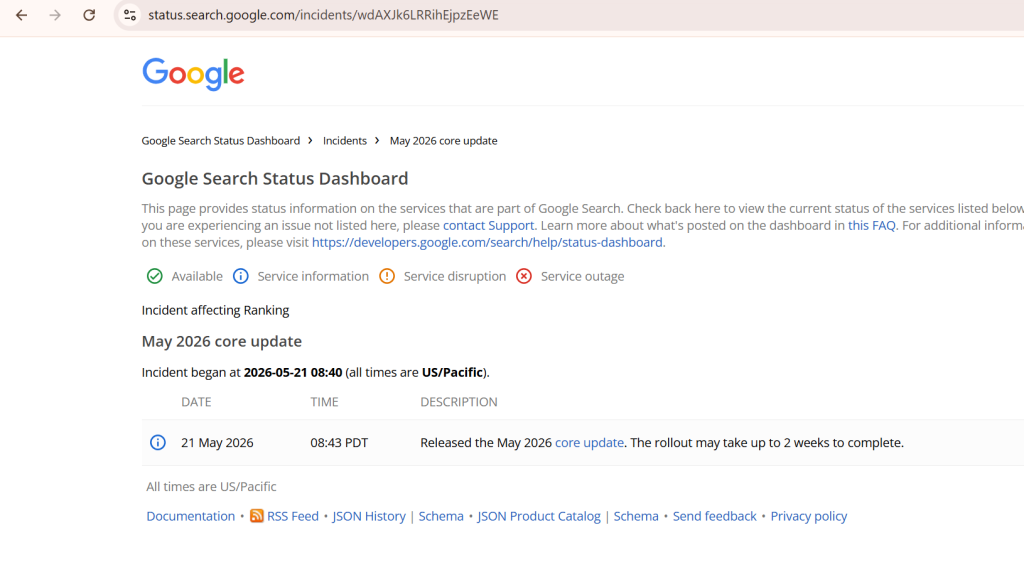
Google’s May 2026 Core Update is rolling out. The bigger story, is what it rewards.
A lot of site owners still treat Google core updates like weather events: unpredictable, uncontrollable, and mostly survivable if you “wait it out.”
That mindset is starting to cost money, and real time too.
- The May 2026 Core Update looks like it is speeding up a shift we’ve been tracking for roughly the last 18 months. Google is getting better at separating info that is actually present and useful from info that got produced because SEO tools claimed there was search volume. This update also seems extra hard on scaled, low-originality publishing patterns.
- So what happens next? Some sites get traffic gains without publishing more pages at all. Meanwhile other sites see 30–50% of their pages lose visibility quietly, even though they technically “do SEO right.”
- Based on the early rollout notes shared by MSN and the wider search community chat, the volatility showed up across verticals almost right away after the rollout started.
The interesting part is not really the volatility. It is which types of sites are shifting, like what goes up what slips and why.
Introduction
• Google’s May 2026 Core Update seems strongly tied to content originality, topical credibility, and real-world know-how signals.
• AI-written content is not the issue. Commodity AI material with zero unique value is, that’s the thing.
• Smaller companies can gain more than big publishers if they lean on niche authority, customer proof, and hands-on operational insight.
What Is the Google May 2026 Core Update Actually Targeting?
The quick answer: Google looks like it is rewarding information gain and putting less weight on plug and play pages.
That distinction counts because plenty of SEO teams keep chasing keyword coverage instead of insight density, or they treat those things like the same one, which they are not.
Core updates historically they refine how Google evaluates relevance and overall quality, but this rollout feels more tied to content usefulness at scale. Sites that lean on thin topical clusters lightly modified AI pages, or what people call “SEO-first” publishing systems are seeing volatility across rankings.
The coverage says this is a broad core update, not a spam update and not a manual penalty. So Google is recalibrating its ranking systems in general, instead of aiming at one isolated tactic.
Here’s the deeper implication, maybe the key part:
Google doesn’t really have to ask anymore
“Does this page answer the query?”
Now it can more and more ask
“Did this page add anything meaningfully new?”
That shifts the content strategy completely.
A local manufacturing ERP company describing implementation failures from real client deployments may now beat a polished but generic “Ultimate Guide to ERP Implementation” that was written from recycled internet research.
That’s a big shift in competitive advantage.
The May 2026 Core Update looks like it’s doing less to punish AI and more to sift through content that’s easy to replace.
Why Are Small Businesses Suddenly Getting Better Rankings
Because Google might be trusting closeness to the real problem more than sheer publishing power.
This is the most overlooked chance in today’s SEO environment.
For years, larger publishers basically owned the SERPs because they could:
• Run huge content teams
• Maintain strong backlink profiles
• Use programmatic SEO systems
• Keep a faster publishing pace
But AI changed the economics of content. Now nearly everyone can create “good enough” informational pieces at low cost.
So Google has to draw lines using stuff that’s harder to counterfeit:
• firsthand expertise
• operational credibility
• real customer touchpoints
• original observations
• proven implementation experience
A 20-person ERP company that helps textile manufacturers day in day out can generate more credible operational insights than a media publisher sending articles to freelancers and hoping for the best.
And Google, increasingly, seems to be noticing.
Example: the “Experience Layer” advantage
Think about two pieces aiming at the same topic:
“How to reduce warehouse inventory errors”
Article A
• Generic SEO article
• AI-assisted
• It summarizes familiar best practices
• Still no real examples
• No operational metrics, at all
Article B
• Written by a supply chain implementation consultant
• Includes real barcode workflow missteps
• Calls out scanning latency problems
• Shows before and after error reduction percentages
• References the real deployment friction you meet in a warehouse
Used to be, Article A could still climb rankings with enough backlinks and careful optimization.
But post 2024, and especially through the 2025–2026 updates, Google increasingly leans toward Article B since it carries “experience fingerprints.”
These fingerprints are hard to mass-produce, i mean really hard.
Small businesses win when they stop sounding like publishers, and start sounding like practitioners (not commentators).
Is AI Content Being Penalized?
No. Unoriginal AI workflows probably are, yes.
And this is where many SEO discussions get a bit misleading, because the nuance gets lost fast.
Google has said again and again that AI-generated content on its own is not the problem, it’s more about whether what you published shows value, originality, and real expertise.
The May 2026 update makes the same separation even clearer.
Here’s a practical framework a lot of teams need right now, with less hand waving:
| Content Type | Likely Outcome Post-Update | Why |
|---|---|---|
| Generic AI summaries | Declining visibility | Low information gain |
| AI-assisted expert content | Stable or improving | An human insight layer is present |
| First-hand operational content | Strong potential gains | Unique expertise signals show up |
| Scaled location pages with weak differentiation | Higher volatility | Thin topical duplication |
| Original research or proprietary data | Higher trust signals | Hard to replicate |
| Human-edited AI content without adding extra know how | Thin long term moat | Still interchangeable |
AI is now a multiplier, not a substitute for expertise.
The best teams are using AI for:
• research acceleration
• outline generation
• SERP analysis
• content structuring
• repurposing
But the rank edge is coming more and more from what happens after the AI layer:
• insights
• examples
• frameworks
• client observations
• contrarian analysis
• proprietary data
That is the real moat.
Google doesn’t care whether AI assisted with creating the content. It cares about whether users could get the same value from 500 other pages.
What Should SEO Teams Do During the May 2026 Core Update?
Do less publishing and more differentiation.
Most teams respond to core updates by pushing output higher. Maybe that is the wrong move.
If your site lost visibility, it might not be the lack of content volume. It can be content sameness, which feels similar everywhere, so search engines kind of treat it as “the same idea again”.
Here’s a smarter response framework, not too complicated once you start:
1. Audit pages for “information gain”
Ask yourself, without skipping:
• What does this page claim that competitors don’t?
• Is there firsthand know-how?
• Is there operational specificity, like real constraints and decisions?
2. Remove or consolidate thin topical pages
A lot of sites built hundreds of near-duplicate pages during the programmatic SEO boom.
Those pages are increasingly fragile.
3. Add proof layers
Include things that verify, not just decorate:
• screenshots
• implementation stories
• metrics
• customer examples
• timelines
• workflow breakdowns
4. Strengthen author credibility
Avoid fake author bios.
Instead use real credibility signals:
• LinkedIn profiles
• conference speaking
• certifications
• case studies
• product involvement
5. Refresh old “SEO content”
Pages written purely for keyword targeting often need full repositioning, not just edits.
6. Measure engagement quality
Rankings alone can be misleading.
Watch for:
• branded search growth
• returning visitors
• assisted conversions
• time to conversion
• direct traffic growth
A Real Pattern coming into view in B2B
A few B2B SaaS and industrial groups are quietly beating the more media-heavy rivals, by posting:
• implementation breakdowns
• pricing clarity
• integration failures
• operational lessons
• customer process changes
This kind of publishing often has lower output but higher trust. And yeah, the higher placements are showing up more often now.
The safest SEO strategy in 2026 is starting to become genuinely hard to replicate.
How Long Will the Google May 2026 Core Update Take to Stabilize?
Most core updates take 2–4 weeks to fully roll out, but recalibration of rankings can stretch longer than that.
That matters, because many teams react too early then they get it wrong.
The rollout note suggests Google has begun deployment but rankings may move around a lot before they finally settle.
Here’s what experienced SEO teams usually avoid during the rollout window:
• mass deleting pages
• aggressive redirects
• domain migrations
• changing an entire site architecture
• rewriting everything immediately
Instead they collect data first.
What You Should Monitor Weekly
| Metric | Why It Matters | Warning Sign |
|---|---|---|
| Non-brand organic traffic | Shows visibility shifts | Sustained decline over 3+ weeks |
| Query diversity | Points to topical authority | Rankings consolidating into fewer terms |
| Conversion rate from organic | Tracks traffic quality | Traffic holds steady but conversions slide |
| Indexed page count | Helps spot crawl and indexing changes | Sudden large drops |
| Branded searches | Measures trust and awareness | Flat or declining brand demand |
| Returning visitor rate | Signals content usefulness | Visitors do not return |
Ranking drops are dangerous. But irrelevant traffic that never converts is worse.
Many sites will lose clicks yet improve business performance if Google filters that low-intent informational traffic.
That nuance gets missed during every core update discussion.
Smart SEO teams check business impact during core updates, not the emotional reaction thing.
The bigger strategic shift most marketers still haven’t really accepted
Google is slowly going from “best optimized” to “most trusted.”
Not perfectly. Not always. But directionally, yeah, that is where it’s headed.
That has huge implications for content strategy.
For years, SEO rewarded:
• content velocity
• keyword matching
• publishing breadth
• SERP replication
Now Google increasingly rewards:
• topical depth
• experience signals
• entity trust
• audience loyalty
• originality
• practical usefulness
So the uncomfortable reality is this:
Many companies built SEO systems that were tuned for a version of Google that may not exist anymore.
The winners in 2026 probably won’t be:
• the companies publishing 1,000 AI pages per month
• the sites that repeat competitor outlines
• the brands chasing every single keyword opportunity
The winners are more likely to be companies building recognizable expertise ecosystems, you know, in a real way.
That includes, expert-led blogs, proprietary research, customer-driven insights, product education, operational transparency, and niche authority that stays put.
Honestly, this might make SEO more human again, ironically enough.
And for smaller specialized businesses, this is potentially the best news in years.
Conclusion
The May 2026 Core Update is another reminder that SEO is no longer primarily a publishing game, not really.
It’s becoming a credibility game, full stop.
The source article does a solid job talking about the rollout and volatility. But the more important discussion is what Google now considers valuable in an internet flooded with AI-generated sameness, everywhere.
- The old SEO advantage was scale.
- The emerging SEO advantage is believable expertise.
- That changes who can win, and it shifts attention fast.

Kumar Swamy is the CEO of Itech Manthra Pvt Ltd and a dedicated Article Writer and SEO Specialist. With a wealth of experience in crafting high-quality content, he focuses on technology, business, and current events, ensuring that readers receive timely and relevant insights.
As a technical SEO expert, Kumar Swamy employs effective strategies to optimize websites for search engines, boosting visibility and performance. Passionate about sharing knowledge, he aims to empower audiences with informative and engaging articles.
Connect with Kumar Swamy to explore the evolving landscape of content creation!