
FAQs Schema was one of the fastest “easy wins” for SEO in 2019.
You upgraded your search listing, gave competitors less visibility to keep them at the bottom of the page, and sometimes even increased CTR even though the rankings had not budged even an inch.
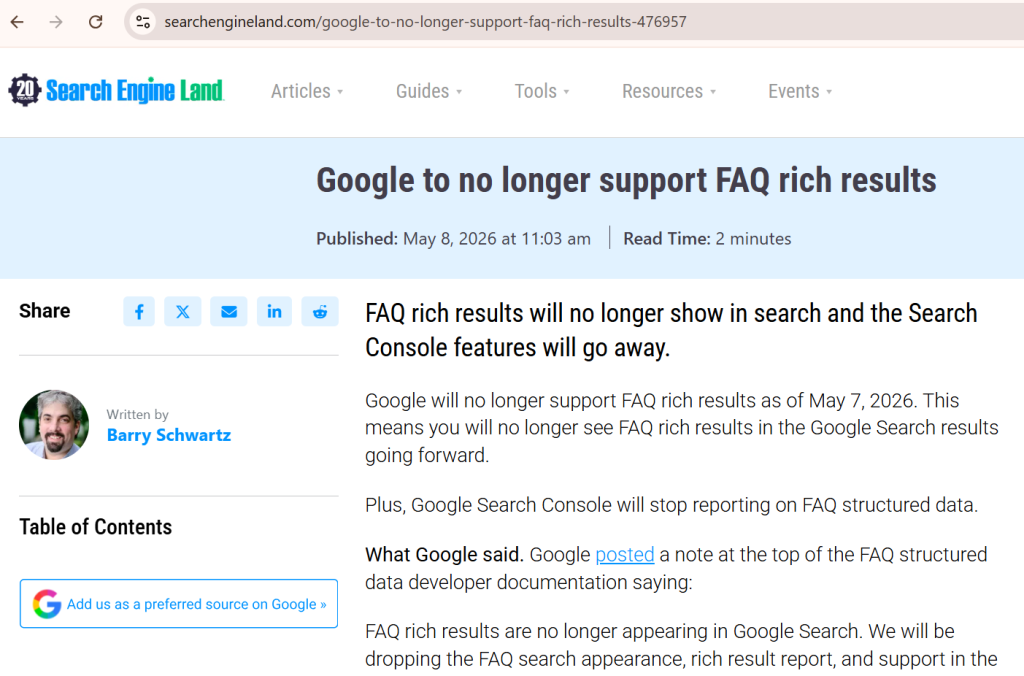
Now FAQ rich results have been shut by Google.
And really, this was not unexpected anyway.
Google has been quietly getting rid of FAQ visibility, limiting it to government and health websites in 2023, and now doing away with the feature entirely by 2026.
It’s not really about the demise of a SERP feature.
The big story is about Google getting after minimizing “decoration SEO” or, processes to win visual space by improvement of screen visibility but without improving usefulness.
FAQ schema is the latest ray to feel the brunt of these new changes.
Key Takeaways
- Google doesn’t support FAQ rich results.
- This signals a more comprehensive shift away to SERP-enhancing measures upholding content quality, authority, and answers which can be read by the AI algorithms.
- Small businesses need not panic, although many lost FAQ visibility years ago with Google’s previous restrictions rollout.
Why Did Google Remove FAQ Rich Results?
Short answer: Google believed that FAQ rich results no longer enhance the quality of search, and instead polluted the SERPs.
In case you want official statement, Dissent runs strong among many more practical people.
By 2022, FAQs had been rendered hopelessly abused.
- Ecommerce pages swamped products with FAQs.
- SaaS landing pages unashamedly filled up web real estate with bloated FAQs.
- Agencies automatic the generation of FAQs in masses.
For quite some time, Google cared nothing about it because structured data eased the machine’s understanding of content.
Over time, it became less about pure information and more about traffic manipulation.
To put time to all this is to digress this:
- 2019-2021 FAQ rich results were widely propagated Creation of steeply rising CTR gains for a majority of webpages.
- 2023 FAQ visibility has been more targeted on government and health websites. Quite a few lost their FAQs.
- 2026 The most daunting day was when Google took the death call on FAQ rich results. The end of the era of FAQs in organic SERP superimposition.
In conclusion, FAQ rich results were, in a way, never taken away outright.
They just took years to fade off slowly.
The question is “Why now?”
Google has been striving to become cheaper.
Since the time of Featured Snippets emerging from a satisfying answer was drawing less attention, it slowly became a hard sell for FAQ dropdown menus.
They are occupying space where Google wants to see:
- AI-generated Overviews
- Shopping applications
- Videos
- Various first-party search features
“Serious house cleaning”
It’s simply like the illumination to the Google database gazette, thus brightening SERP real estate.
Should I remove FAQ Schema’s from my website?
Short answer is that you don’t have to unless it’s for some reason you have determined concomitant with this tactic.
But you have to take a different SEO approach with AMAZON FAQs.
Google has confirmed that FAQs can be kept during the structured data test.
Search engines and other systems can proceed to use it.
This is a critical stand.
The structured data framework on its own is not “bad.”
What has been discontinued is the FAQ search enhancement.
For most websites, this is the best move to adopt:
Keep FAQ content when it serves the users well
If your FAQ actually shortens the friction, leads to conversion, or promotes customer education, retain it.
Trash useless or low-quality FAQs
Trash these when the FAQs only exist to fill the pages with keywords or uplift SERP listings for maximum visibility and viewing.
Reconsider FAQ positioning
Many sites just buried their most important buying objections within accordion FAQs, and this content might now deserve better placement toward the top of the page.
Commonly it is here that many SEO teams get it the wrong way round.
They honestly express that the FAQ contents have become useless with the loss of the spangled FAQ snippets.
The actual truth is quite the contrary.
With a crucial emphasis on clear question-and-answer usage, the search systems have to acquire a lot of relevant structured data.
This is because these language models are programmed to identify direct answerable content.
The dropdown may not be anymore when it comes to Google, but AI systems will still recognize the underlying data architecture for sure.
Wrap-up: The FAQ schema might seem to have disappeared, but structured answer content would continue to find significance in AI-powered discovery processes.
So What Do All These Mean for the Little Guys?
Pithy answer: Chances are, probably less traffic impact than you think but more thin ice beneath your feet than you would care to accept.
Therefore, since for several years now, rich FAQs were still butchered at the neck with Google limiting them to the health and government websites, that means-date wise-the “loss” occurred a long time ago for most SMBs.
But, post-By June 2021, another paramount issue soon becomes clearer.
Quite simply, the small enterprises, when corpse-like dependants on technical SEO, are like invertebrates scared to build authority.
Why did FAQ schema catch attention?
The promise of distorted benefits of visibility existed without too much of a strong brand, good products, or supreme expertise.
The spring of that age is going off.
Google now increasingly rewards:
- Expertise
- Brands everyone knows
- Innovative thoughts
- Customer-focused content
- Topical development
- Multiformat content ecosystems
The truth is that a local accountant with generalized FAQ pages might have good fortune.
However, an accountant for a niche tax, sending out original tax insights, calculators, video explainers, along with realistic case studies, sees a much brighter future.
Here, though, lies the bigger change that is going to be enough: under the name of local accounting firms, everything is vastly different.
So where should SEO teams shift their focus from total FAQ rich results?
Shift from “SERP decoration” to “answer optimization.”
Now we’re getting into the most interesting part of the discussion.
So many SEO teams are still trying to optimize for what search looked like in 2021:
- Blue links
- Featured snippets
- FAQ dropdowns
- Position tracking
- CTR manipulation
Nowadays, search behavior is splintering into:
- AI-generated results
- Chattable search
- Voice assistants
- Zero-click search
- Multimodal search experiences
The old playbook is losing leverage.
Old SEO Focus → New SEO Focus
- FAQ schema → Entity authority → AI systems trust recognized brands
- SERP pixel optimization → Answer completeness → AI extracts complete answers
- Keyword matching → Intent coverage → Search is becoming semantic
- Thin FAQ pages → Expert-led resources → Expertise drives citations
- Click-through tricks → Brand recall → Many searches now end without clicks
Key insight: SEO is shifting from ranking pages to becoming a trusted answer source.
This is why many AI-generated search responses increasingly favor:
- Research-backed content
- Industry studies
- Expert commentary
- Original frameworks
- Unique datasets
Not generic FAQ pages.
During my involvement with a SaaS company, one of them decided to eliminate a large part of their templated FAQ sections and included mostly:
- Implementation guides
- Benchmark data
- Customer workflows
- Migration checklists
- ROI calculators
Initial organic traffic dipped by 6%.
After six months, branded search volume showed a marked increase of 22%, demo conversions were far better, and their pages were more visible in AI-generated answer summaries.
This is what contemporary SEO increasingly rewards.
How Should You Audit FAQ Content Now?
Short answer, treat this as for a content quality audit rather than a schema clean-up project.
Anytime spent in discussions would make no sense, should we be keeping that markup?
This is a wrong approach.
A better question to ask should be:
“Does this FAQ content serve a purpose outside SEO tricks?”
It should be done like:
1. Export the historical data of performance of FAQs
If FAQ CTR or impression-driven SEO metrics were monitored, archive that information as soon as possible and keep it for benchmarking and reporting.
2. Marking Pages Verily Dependent on FAQ-driven CTE Improvements
Look for:
- CTR declines
- Impression drops
- Desperate for engagement
- Turns of non-brand traffic
3. Sort your FAQs into three buckets
- Helpful and conversion-driven
- Useful but redundant
- Pure SEO filler
4. Elevate most helpful FAQs to more engaging content
Turn good questions into:
- Standalone articles
- Comparison pages
- Troubleshooting hubs
- Video explainers
- Interactive tools
5. Reformulate AI-readable answers
There’s a pattern AI systems fancy:
- Concise definitions
- Directness in replies
- A dense structural format
- Hearty, deep contextualization
6. Expand on ranking
Track:
- Assisted conversions
- Growth in branded searches
- AI citations
- Return visitors
- Sales with a significant increase in traffic
Takeaway: The future SEO stack measures influence and visibility, not only rankings and snippets.
Did Google Make the Right Decision?
The short answer is generally yes but there is a counter-argument being made.
FAQ rich results are thus noisy in search quality.
The majority of them were either repetitive, of little value, or deceptive, which, with the implementation of policy, was terribly deterring to usability.
However, the delete button was used to eliminate one of the few avenues minor publishers had through which to win a visual battle against major competitors.
And so it does matter.
In summary, search engines have results made by some small publishers.
However, the scale is tipped in favor of big business, meaning the large brand already had further down the following:
- Stronger authority signals
- Higher click trust
- Broader distribution
- More backlinks
- More branded searches
SERP additions have been the lambs that fattened the lions on the present playing field.
Without such supports, the struggle for visibility has to be given over to the establishment of the authority.
This will keep contending until today.
Rewards shall be given to worthy content, says Google.
But visibility relies more and more on:
- Brand recognition
- Platform authority
- Entity trust
- Factors pushing competition further
So much is at stake:
- Conversion growth
- Relationship building
- Really more conversion opportunisms
Here is why these things are decisive for any plan:
- Audience motivation
- User intent
- Content structures
- Authority recognition
- Channels of distribution
- Discovery AI
Now, what’s ironic?
FAQ content is still relevant.
But not because it feeds pretty, slick dropdowns.
It matters because good marketers understand what questions their customers commonly ask better than anyone.
That skill is likely to become important in marketing, not fade into the dust.
Conclusion
Google is removing the FAQ rich result.
But does that, then, spell the end of structured data?
That is a summarized conclusion on the subject.

Kumar Swamy is the CEO of Itech Manthra Pvt Ltd and a dedicated Article Writer and SEO Specialist. With a wealth of experience in crafting high-quality content, he focuses on technology, business, and current events, ensuring that readers receive timely and relevant insights.
As a technical SEO expert, Kumar Swamy employs effective strategies to optimize websites for search engines, boosting visibility and performance. Passionate about sharing knowledge, he aims to empower audiences with informative and engaging articles.
Connect with Kumar Swamy to explore the evolving landscape of content creation!