
Introduction
- Here points on the many gates of AI search pipeline where content fails, so startups get an advantage by determining these points.
- Time and again, small businesses neglect the importance of AI for search query content, as they miss the most critical points of effectiveness as per relevance, applied factuality, and the demanded scale within an efficient scenario.
- Using AI-assisted audits increases organic rank and paid content performance across search engines.
Ever wish you could search on Google and find the relevant information, which does not necessarily include all the webpages Google has to offer? Well, knowing about the 10-gate AI search pipeline should help this defines the ranking and evaluation circle that content passes through under Artificial Intelligence. For any small business, this is far more than a tech trend; this is an opportunity to understand the failure points in content strategy of their competitors and to better set their content strategy.
However, here is the thing: the AI doing these ranking algorithms and sorting algorithms is far from perfect. Realizing where the content is weak in the 10-gate AI search pipeline can make room for growth if employed by any company disabling as a small firm which may lack large marketing departments or budgets.
This article goes through the 10-gate AI search pipeline, identifies points of failure in content that are becoming commonplace, and finally offers some practical steps to help businesses optimize their content and visibility.
Don’t we consider the “10 Gate AI Search Pipeline”?
The ten-gate AI search pipeline is a series of filters applied by AI search engines to screen and rank online material. They are used to assess its alignment towards search intent, relevance, credibility, and quality. These gates serve to separate the wheat from chaff and thus prevent users from accessing unsatisfactory stuff and see to it that any search brings up the correct and meaningful result.
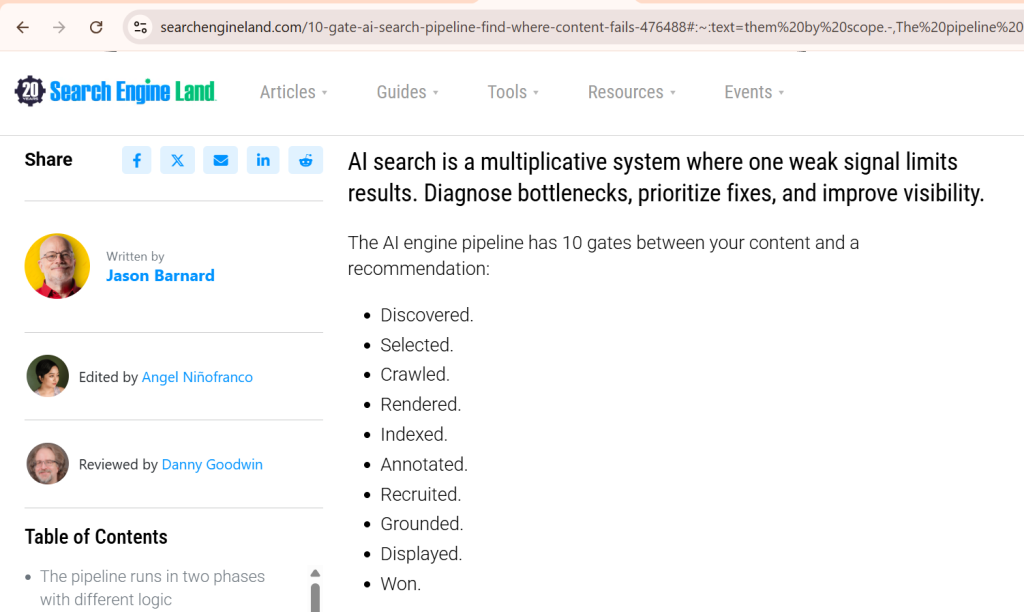
In simple words, the ten gate AI increasingly screen involves such steps as keyword relevance, content accuracy, contextual understanding, user intent prediction, and so forth.
What Could Be The Benefit Of A Small Business?
It is key for little businesses to deal with the: manner in which AI systems filter and sort through content before it garners a ranking. Many of the tools and strategies that ought to be the basic kit of larger names are available and can also be used, but businesses in the smaller category often miss out, or rather greatly misunderstand the AI ranking process. With dedicated effort for these gates, small businesses can raise their content visibility and even outcompete others, even leading them to win the fight with limited resources-a dream come true for any small entrepreneur.
Simply put, the small businesses capable of aiding the insights of the AI traffic pipeline can stand toe-to-toe with big players.
Gate 1: Relevance (Keyword) – Are You Speaking Their Language?
Now, content has to pass through gate 1. In Gate 1, engines have a set of yardsticks in place to judge that any content that is not closely related to a query should never make it into the ranking. This yardstick is all about how relevant a content’s keywords are to the terms that are searched for by the engines. Old or misplaced keywords will only see the gate closed on them-the content was great otherwise but was put out of reach for being cited.
Remember, for small businesses, long-tail keywords are their friends and with hyper-specific search queries, they can win over niche audiences, which usually give a higher conversion since the search queries are laser-focused.
What To Do:
• Opt for fine keyword research with the likes of SEMrush, Ahrefs, and Google’s Keyword Planner.
• Make sure your content directly answers the searcher’s query.
E.g.: If you’re running a local bakery, instead of focusing on generic keywords like “best bakeries,” try more specific terms like “best gluten-free bakery in [City Name].”
Gate 2: Content Depth Are You Providing Enough Value?
The AI shall be at this stage looking for content depth and comprehensiveness. Content that barely skims the surface or is under 500 words usually fails to cross this Gate. AI from Google loves when a lot is clearly shown, with a deep dive on a given topic; yet AI also penalizes for irrelevant fluff, so a balance between providing quality content and over-inflating it becomes a balancing act.
Business Tip: Make sure your content addresses not only the principal objective but peripheral questions too. For instance, if you belong within the fashion sector, don’t limit your writing to covering “summer dresses”, but go further with the best fabrics for the hot climates, a background on summer globes, and ways to style that perfect summer frock with different body shapes.
What to do:
• Your content must be at least between 1,500 to 1,500 words long.
• Provide real practical help but not just regurgitated information.
Illustrative: A blog titled “How to Choose the Best Running Shoes” could easily go on to developments taking place in shoemaking technology, what each development has as an advantage or disadvantage, and some expert advice.
Level 3: Content Freshness- Is Your Content Fresh?
Search engines give attention to the new. Should your blog article, product page, or landing page hasn’t been updated in too long, it’s usual to perish this gate. This is especially true in sectors such as tech, health, and eCommerce, where updates are made frequently.
Small business tip: Have your content kept up to date, reflecting the latest industry standards, trends, and news. Google’s freshness algorithm stresses pages written by frequently updated sites with fresh info.
So, what to do:
• Conduct content audits frequently.
E.g., If your company sells eco-friendly cleaning products, make sure the product descriptions talk about the latest environmental legislation or sustainability trends.
Gate 4: User Intent Alignment Does Your Content Satisfy User Intent?
In this regard, AI has become noticeably expert in predicting intent behind searches. Content recommendations from search engines are stemmed in user behavior and, in most cases, spurred by intent. But for the content to clear this stage, it is crucial that it be aligned most definitively with user intent.
Small Business Tip: Before composing any content, always ponder and figure out what the user wants from it, then make your content fit for serving that intent whether it is information, purchase, or navigation.
Things to do:
• Use intent analysis tools to figure out questions the sectors of interest in the market are asking, including Answer the Public or Ubersuggest.
• Design your content in the light of user intent, and not just keywords.
An example: While an article optimized for “how to start a business” could enumerate various steps, it would not be fulfilling the actual user needs as the best content would be the one that walks readers through the run-through of securing investment, business registration, and other operations.
Gate 5 is about Content Authenticity: Is the content credible?
Central to everything is credibility- AI models check the rubric of your content by checking its authenticity and worth. The AI looks at how the minuscule of the citations, clickbait, or claimed experts are treated as the ground for not letting the content pass beyond the checking of Gate 5. The AI also has been trained in recognizing both good and bad sources, and this capacity can make a platform to further distinguish between serious and great exaggeration around credibility.
Small Business Tip: You’ve built your content, so factors of trust should be taken into consideration. Use citations and backlink to trusted sources. Small businesses doing all of the above will partner with influencers, quote relevant case studies, or show real-world evidence that supports their case.
To Do:
• Include evidence and backlinks from reputable sources.
• Avoid any clickbait. Ensure the content is still a reality based on the promises made.
For example, if your brand has helped to achieve a 30% energy-energy savings rate for the clients, refer to this fact in your content, with a preferred link to a real case study or testimonial featuring this success.
Gate 6: Artificial Understanding of Context Does Your Content Hold Meaning?
AI does not simply look at keywords but is decoding the meaning by determining context. This gate seeks to see whether your content makes sense to the searcher when placed within a context. AI’s understanding of the word(s) relations and improving at breakneck speeds to provide not just relevance, but meaning.
Look at this small business tip: Explained content logically for both AI and human readers with headings, subheadings, and clear paragraphs.
What to do:
Slap on structured data (schema markup) as much as possible so the search engines may gain a meager grasp of what your content is about.
Write flowy content addressing problems from multiple viewpoints.
Another example could be restaurants that ask readers to comment on photographs that they post under a new recipe, perhaps from a new practice, and, thereby, draw us into conversation.
Gate 7: Content Engagement Are Users Interacting with Your Content?
Another essential gate is whether your content is being interacted with by users. Users’ interactions with your content are measured through such matrices as the time spent on the page, bounce rate, and click-through rate. The content that the program has to deal with is in an identical array and will simply not pass this gate if the user does not interact with it.
Insider Tip for Small Businesses: Concentrate on making engaging and interactive content that keeps users hitched. Create anything you need to keep people on-target with your content; for example, infographics, videos, and quizzes can greatly increase content engagement.
WHAT TO DO?
• Introduce visual breaks (images, charts, videos) on the text side.
• Encourage your reader to leave a comment, share, or click elsewhere for more resources.
EXAMPLE: A location’s restaurant can add in the local blog an immediate poll, even a code for a discount, in return for participation with the content.
Gate 8: Mobile Optimization- Is Your Content Mobile-Friendly?
Google ranks mobile-optimized content higher following its AI model. With mobile-first indexing entering the picture, you should make sure that the content is not poor in mobile device optimization.
Small Business Tip: Make sure your website and contents will be able to load quickly and will look excellent on all mobiles and tablets. You can use the Google Mobile-Friendly Test tool to verify the suitability of your contents.
Things to do:
• Use responsive design for your websites.
• Test all pages for mobile performance.
So, for instance, an online store could lose a great deal of potential business if would-be costumers did manage to open its page on mobile, Frank considering understanding that the number of individuals moving ahead in this era is already considerably greater.
Gate 9: Site Architecture- Is Your Content Easily Accessible?
Accessible content ranks high, in the hands of AI. The same, therefore, applies to site architecture. An infraction at either end will cause your content to trudge through these gates.
Small Business Tip: Ensure the simplicity and ease of your site architecture. Having a good-looking navigational menu, solid internal linking, and consistent URL format all improve the chances of passing this gate.
What to do:
• Keep a clean URL structure, and keep all internal linkages plain.
• Ensure that anyone can find your important content within two to three clicks from your home page.
Example: Your blog on-site should be easily accessible from the home page while doing so should provide an airy feeling, i.e., not be buried under numerous levels of sub-pages.
Gate 10: AI Interpretation of Multimodal Content Provide Visual Elements!
For example, artificial intelligence now considers image, audio, and video as contributors to the final content: search engines are therefore able to better interpret and rank content that includes various forms of media.
Answer: Along with your writing content, add something invisual/media format also i.e. images, video, audio.
What to do:
• Utilize high-quality images, videos, and other media that harmonize with your text.
• Comprehensively describe all visuals in alt text.
Example: If a product page includes images, with explanation videos and customer reviews, it will possibly be scored higher by an AI than a plain text product page.
Conclusion
A quick error-free draft of any major amendments used in enhancing the navigation of an AI designed 10-gate search pipeline concerned with rendering the contents arresting to a searcher. This era offers smaller businesses a chance at challenging big corporations by providing working AI-optimized content that assists users, practices well, and utilizes AI technology as a springboard for further evolution.
From gate to gate, the value of AI-enabled content optimization springs from realizing the user’s expectations such as the higher quality and conserving or enriching the relevance of content across the content life cycle.

Kumar Swamy is the CEO of Itech Manthra Pvt Ltd and a dedicated Article Writer and SEO Specialist. With a wealth of experience in crafting high-quality content, he focuses on technology, business, and current events, ensuring that readers receive timely and relevant insights.
As a technical SEO expert, Kumar Swamy employs effective strategies to optimize websites for search engines, boosting visibility and performance. Passionate about sharing knowledge, he aims to empower audiences with informative and engaging articles.
Connect with Kumar Swamy to explore the evolving landscape of content creation!