
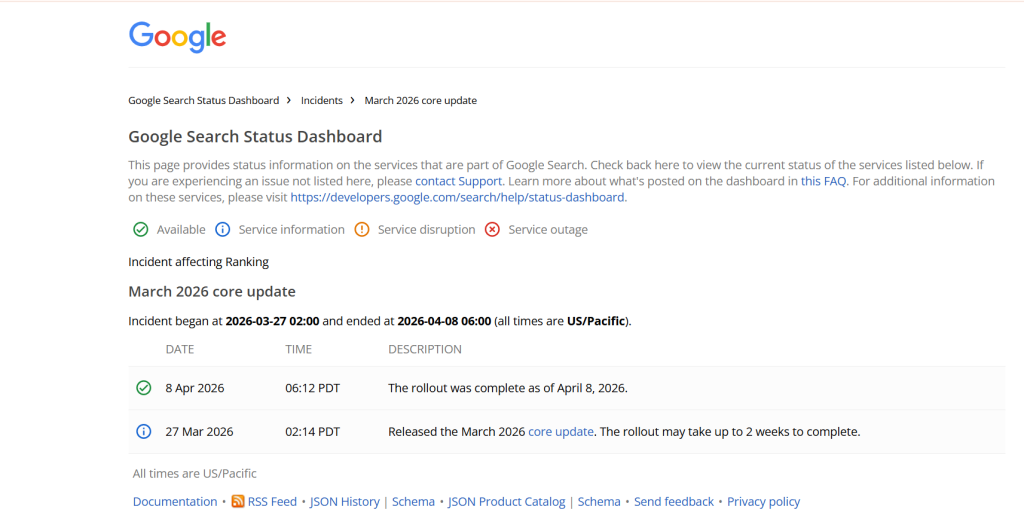
Google’s ultimate roll out for March 2026 Core Update that happened over a span of 12 days, set in place the stringent algorithm changes. Now that the wind has blown, what do you think will happen to you and your content strategy? Are you feeling any effects? It is not too late to think about checking rank, discerning what has moved, and adjust your strategy!
The Thing to Remember
- The Full Rollout from the March 2026 Core Update came to an end after 12 days, affecting search results and rankings.
- Small businesses under the first-digit sector have above all to look upon content quality and relevance with relation to updated signals of Google ranking.
- Adjusting your content strategy also means understanding about Google’s bigger shift towards user satisfaction, E-A-T, content quality.
How Will the Google March 2026 Core Update Affect Your SEO?
In one word: popularity. This update reinstates the commitment Google has to rewarding content with a real-world reward to please user intent.
The main focus of core updates from Google is typically to enhance user experience by fine-tuning how search results are ranked. March’s 2026 update was no different; it placed a heavy emphasis on content that resonates with what users are actually searching for. Small businesses, particularly those with limited SEO resources, should take heed of the shift.
What actually changed?
Google hasn’t given any specifics about the elements they changed but an understanding of broad themes can be gotten-and these three are: better content quality, improved E-A-T (Expertise, Authoritativeness, and Trustworthiness), and relevance, which is thematically similar to the last core update. At a high level of understanding, the update carries an increased focus on content depth and authority, throwing the very existence of smaller, less-established sites into question if they had been depending on thin content and SEO hacks.
Here’s what you should be taking off: If your current rankings show decline, your content must be evaluated for trust and expertise.
What are the steps that small businesses to take ?
It’s simple: Create good, informative content that solves real user problems.
Many times, at small enterprises, the Google core upgrades are notorious in discriminatory effects upon those SEO and content creation functions, namely where the minor resources and budget are allocated. With the March 2026 core update, the importance of valuable content that assists users is laid down for good practice, leaving aside anything that might be spun for SEO or just be standard content.
Here are a few suggestions for small businesses:
- Do a content audit: See whether your content meets the criteria of being comprehensive, relevant, and helpful to users.
- Work towards establishing authority: Position your website in such a way that it can become an authority for the niche in terms of trustworthy reviews, the evaluations of specific traits, etc.
- Session the theme of user experience: Before the update, at least, make sure that your website is easy to browse. Look for good loading times and a mobile-friendly layout.
Take the example of a small B2B SaaS company in the CRM domain, which potentially saw some decreased traffic because they were depending on high-volume keywords rather than giving more attention to creating useful and in-depth CRM best practices, customer loyalty, and case studies. They would be able to recoup their lost rankings by going for a long form content strategy that provides applicable and authentic inputs alongside industry insights.
What’s the Counter-Argument to Google’s Core Updates?
Short answer: A small business is hard-pressed to keep up with constant changes, many of them being elusive.
It indeed is a noble goal that Google is after, a better user experience and content quality; but it appears core updates quite often to hurt the smaller businesses in keeping up with their rankings: basically, these updates and the subsequent changes induce abrupt shift in traffic, so that the SEO have to be recalibrated, recalibrated, and recalibrated.
The challenge: Google has provided opaque communication about how individual sites might be affected, often leaving businesses to try new content strategies and hope for the best. For big-budget SEO work, results are not always true for smaller companies, making the guidelines seem nonequivalent.
Summary: The changes are implemented to improve the user experience but can, due to the swiftness of the change and minimal explicit communication, end up casting a shadow of doubt over smaller players unable to react to them.
Where Can You Measure the Impact of the March 2026 Core Update?
Answer: Use the analytics that follow organic traffic, rankings, and user engagement to estimate how the update may have impacted the SEO strategy.
You should monitor website traffic, rankings, and engagement after you do website updates and view the changes in traffic that may have happened during that period. Google Analytics and Google Search Console’s data may help you in understanding how the core update has influenced a specific page or keyword. Observing these factors may narrow down apparently affected pages or areas of the website:
- Ranking shifts among tailored high keywords; and maybe
- User behavior changes, i.e., bounce rate, time on the site, and conversion rate.
The main metrics to quantify are as follows:
- Organic traffic ups and downs between two dates.
- Changes in SERP rankings of targeted keywords·
- User engagement (metrics like bounce rate, time on site)
- Conversion rates
For Instance, a small e-commerce website may run into a situation where despite continuing SEO activities that work before and seeing consistent growth in sources like organic traffic, a notable drop in the number of organic leads is suddenly seen. Investigation of the Google Analytics will reveal that the pages are no longer ranking highly for some particular terms. After making the adjustments to better target user search intent and implement strong technical SEO, these pages’ rankings and traffic are likely to improve.
A Comparison of Strategies: Content Quality versus Keyword Optimization
Q: Does the latest update put more stress on content quality instead of keyword optimization?
A number of people out there continue to place high regard with respect to keyword optimization as central to SEO success. While it is true that ranking for the right keywords is compelling, the update of 2026 proves that a keyword strategy all by itself will not make the cut. Now, the quality of the content is at the forefront, with high points for length and content depth, relevance, and authority.
| Factor | Content Quality Focus | Keyword Optimization Focus |
|---|---|---|
| Relevance to User Intent | Very High | High |
| Depth of Content | Very High | Medium |
| Keyword Stuffing | Low | High |
| Content Authority | Very High | Medium |
| User Experience | High | Medium |
Key takeaway: Keyword optimization is key, but the actual quality and user experience are given more importance in terms of rankings since the March 2026 update.
Next Steps: So, What Can One Focus On Now?
Quick solution: Periodic content audits, followed by technical SEO enhancement and, last but definitely not the least, catering to dynamic user experiences.
For those experiencing some observed shifts in ranking post-update, the best thing to do is review the content strategy. To stay ahead of changes, a regular content audit, strong focus on E-A-T principles, and superior user experience delivery are your requisites.
Here is your step-by-step strategy backup:
- Perform a content audit of critical content hubs so that opportunities for improvement can be identified.
- Specify and amplify expertise, authoritativeness, and trustworthiness in whatever content you present.
- Ensure a user-friendly approach, making your site run fast, be mobile-friendly, and be easy to assume.
- Track keyword ranking and adjust according to user intent.
In conclusion, the June 2026 Core Update done by Google has once again brought to the fore the importance of supplying superior user-focused content. Small businesses that can adapt to change sooner will have an edge in this increasing SEO competition.

Kumar Swamy is the CEO of Itech Manthra Pvt Ltd and a dedicated Article Writer and SEO Specialist. With a wealth of experience in crafting high-quality content, he focuses on technology, business, and current events, ensuring that readers receive timely and relevant insights.
As a technical SEO expert, Kumar Swamy employs effective strategies to optimize websites for search engines, boosting visibility and performance. Passionate about sharing knowledge, he aims to empower audiences with informative and engaging articles.
Connect with Kumar Swamy to explore the evolving landscape of content creation!