Introduction: Are people really “talking” to AI… or still typing like Google?
Most marketers thought that search behavior would be immediately replaced, due to the ushering of chatbots into the realms of search through ChatGPT. People are today, indeed, effectively using interactive voice search in full sentences and casual conversational mode.
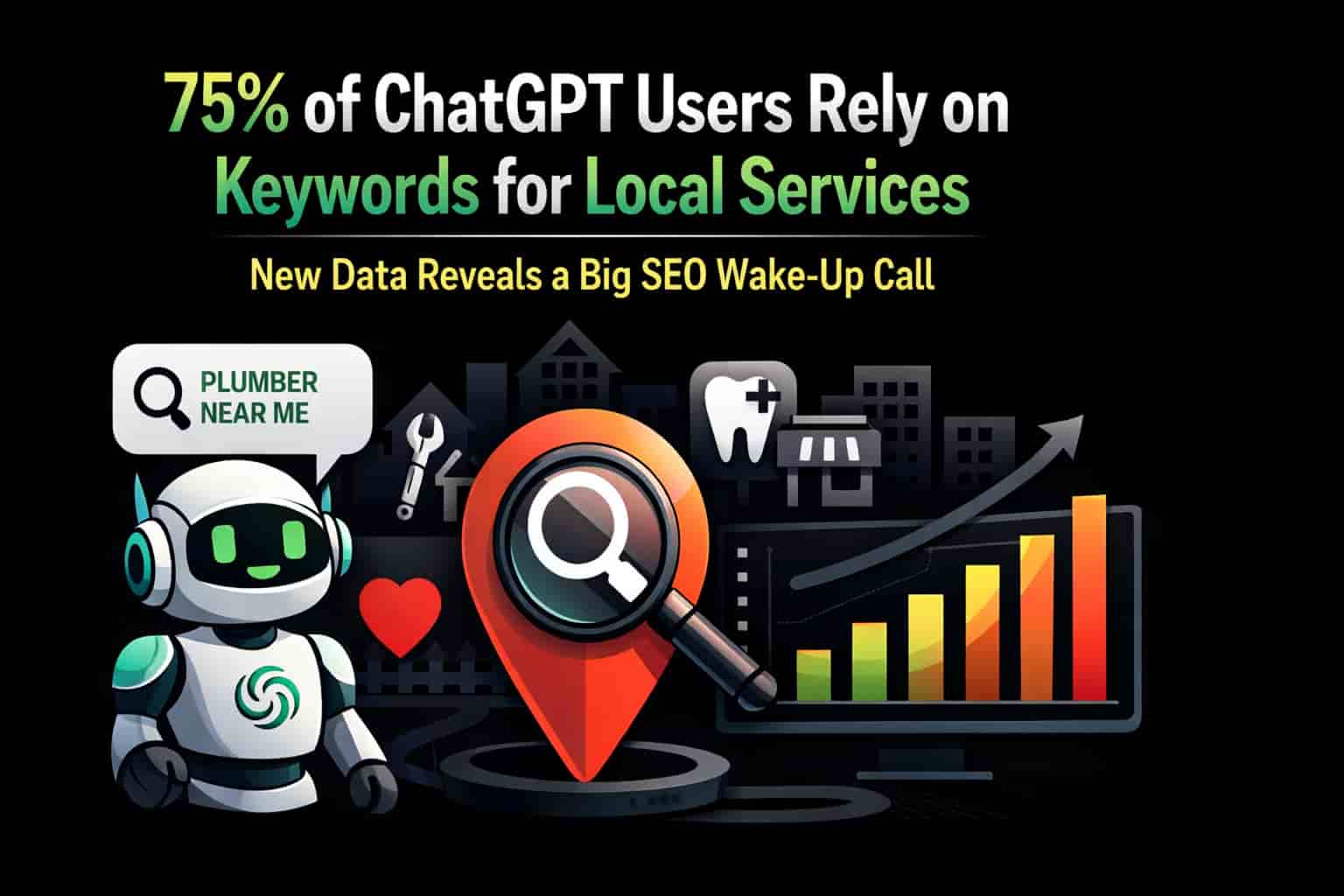
New and up-to-date research shows that 75% of ChatGPT users rely on these robotic and predetermined actions when searching for local services. What is meant by this is that when you search for keywords like plumbers, dentists, digital marketing agencies-is it conversation? No, it is still searching.
Local companies and SEO professionals really need to understand the importance of this issue.
What role does the data play in local searches by users utilizing ChatGPT?
The data from the study has revealed something somewhat familiar. Albeit the very core design for an AI tool to allow more of a conversation-based medium, most of ChatGPT users are relapsing into the classical style, by the very dint of necessity, of typing in search for local services. Imagine searching for “best electrician near me” or “SEO agency in Bangalore,” and you will understand what is meant by it, which makes ChatGPT conversations sound more like normal ones.
This behavior mirrors traditional local search patterns and confirms that keyword-based local SEO is far from dead even inside AI-powered search tools.
As local SEO consultant Raj Malhotra puts it, “AI hasn’t replaced search intent. It’s just changed the interface.”
Why are keywords still dominating ChatGPT local service searches?
The reason is simple: keywords are fast, clear, and predictable.
When users want a local service, they’re usually in problem-solving mode. They don’t want a conversation they want results. Typing short, high-intent phrases feels more efficient, even inside AI tools.
This also explains why local search intent, near me searches, and service-based keywords continue to outperform conversational prompts in AI-driven discovery.
How does this impact local SEO strategies right now?
If you’re optimizing for local visibility, this data is a green signal not a warning. It tells us that traditional local SEO tactics still work, even as AI platforms evolve.
Businesses should continue focusing on:
Optimizing Google Business Profiles
Using location-based keywords naturally
Creating service-specific landing pages
Building consistent local citations
This aligns closely with strategies we’ve covered in our guide on local SEO trends for small businesses on iTechManthra, where search intent remains the backbone of visibility.
Ignoring keywords in favor of “AI-only” optimization could actually hurt local reach.
What does this mean for marketers using AI search tools?
For marketers, this data clears up a big misconception. AI search doesn’t replace SEO it rewards good SEO.
ChatGPT and similar tools pull from structured, keyword-optimized content when surfacing local service recommendations. That means businesses already investing in local keyword research, AI search optimization, and location-based content are better positioned to benefit.
Digital strategist Ananya Rao sums it up nicely: “AI tools don’t guess. They rely on signals we’ve been optimizing for years.”
Are conversational searches completely irrelevant then?
Not at all but they play a supporting role. Conversational queries are more common in research-heavy searches, not urgent local needs.
For local services, keywords still signal urgency and intent, which is why they dominate.
The smartest approach blends both structured keyword content supported by natural language explanations. We explored this balance recently in our article on how AI is reshaping search behavior, and the takeaway is clear: fundamentals still win.
FAQs
Do ChatGPT users really use keywords for local searches?
Yes. Data shows about 75% rely on keyword-style queries when looking for local services.
Does this mean local SEO is still important?
Absolutely. Keyword-based local SEO remains crucial, even in AI-driven platforms.
Should businesses change how they write content for ChatGPT?
They should enhance clarity and structure but not abandon keywords.
Are “near me” searches still relevant in AI tools?
Very much so. Location-based intent remains strong across platforms.
Is conversational search useless for local businesses?
No, but it complements keywords rather than replacing them.
Conclusion: Old-school keywords, new-school platforms
The big lesson here is reassuring. Even as AI tools like ChatGPT grow, people don’t abandon habits that work.
For local businesses and marketers, this means staying grounded in proven SEO practices while adapting content for AI visibility not chasing trends blindly.
If you’re working on local SEO or AI-driven discovery, now’s a great time to audit your keyword strategy and see where you can improve. Got thoughts or questions? Drop a comment or share this with someone still confused about AI search.

Kumar Swamy is the CEO of Itech Manthra Pvt Ltd and a dedicated Article Writer and SEO Specialist. With a wealth of experience in crafting high-quality content, he focuses on technology, business, and current events, ensuring that readers receive timely and relevant insights.
As a technical SEO expert, Kumar Swamy employs effective strategies to optimize websites for search engines, boosting visibility and performance. Passionate about sharing knowledge, he aims to empower audiences with informative and engaging articles.
Connect with Kumar Swamy to explore the evolving landscape of content creation!