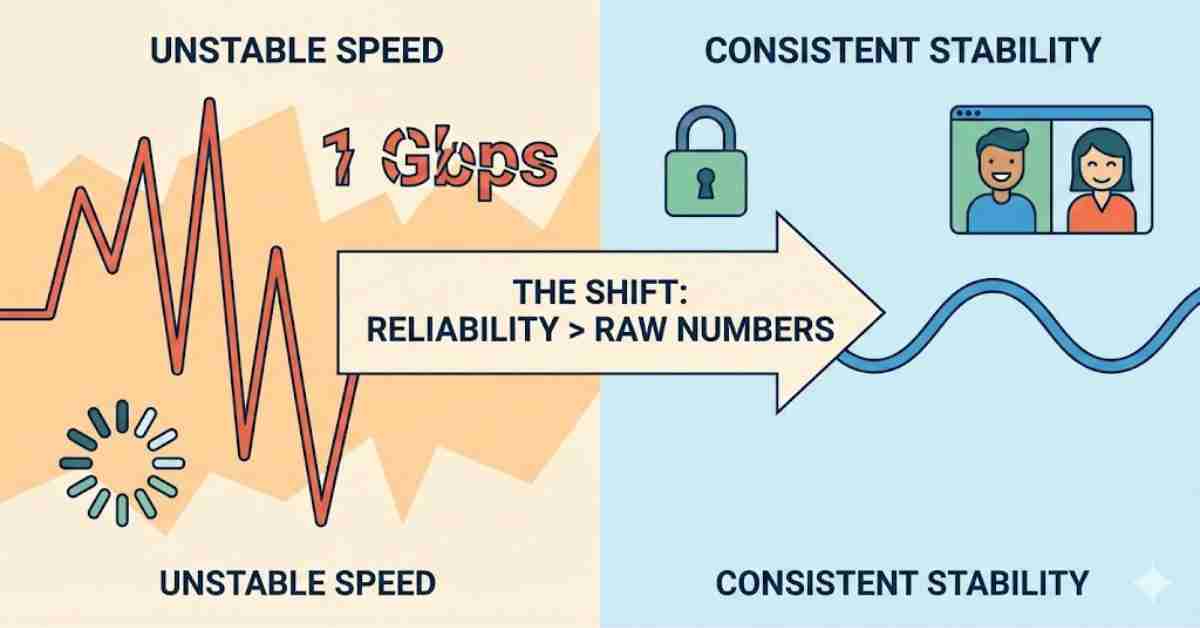
Everyone’s been chasing faster internet for decades. Bigger numbers, better bragging rights. But here’s the thing: most people don’t actually need 1 Gbps downloads. What they need is a connection that doesn’t drop out during a Zoom call with their biggest client.
The conversation around connectivity has quietly shifted. Raw speed matters less than it used to. Consistency? That’s become the real currency.
Speed Numbers Lie (Sort Of)
Your ISP advertises 500 Mbps. Great. But what happens when that 500 drops to 12 during peak evening hours? Or when your VPN connection resets three times during a file transfer?
Speed tests capture a moment in time. They don’t show the stuttering, the buffering wheels, or the failed uploads that happen throughout an actual workday. Remote workers figured this out fast when pandemic-era home offices exposed just how unreliable residential connections can be.
Video calls are the perfect example. Teams and Zoom don’t need much bandwidth at all (maybe 3-4 Mbps for HD). What kills them is packet loss and jitter. A rock-solid 25 Mbps connection will outperform a flaky 200 Mbps one every single time.
The Case for Staying Put
Connection stability goes beyond just keeping video calls running. There’s a growing category of users who need their IP address to stay consistent too. A static residential vpn solves a problem most people don’t realize they have until they hit it.
Rotating IPs trigger security alerts. Banks freeze accounts. Payment processors decline transactions. Services that cycle through different addresses constantly create friction that static connections simply avoid.
And it’s not paranoia. Kaspersky’s research teams have documented how connection instability creates security gaps. Each time a session drops and reconnects, there’s a window where authentication tokens refresh and credentials transmit again. If you find yourself frequently troubleshooting your proxy and network settings due to these drops, you are likely witnessing this security friction firsthand. Attackers know this, and account lockouts from ‘suspicious activity’ often trace back to nothing more than an IP address changing mid-session.
Where This Actually Shows Up
Think about anyone running automated tasks. Price monitoring across retail sites. Social media scheduling tools. Data collection for market research. These systems don’t care about peak download speeds. They care about not getting interrupted.
Harvard Business Review put some numbers to this problem: businesses lose around 545 hours per year to connectivity disruptions. Not slow connections. Disrupted ones. That’s entire weeks of productivity vanishing into “please wait, reconnecting” messages.
Gaming communities understood this years ago. Esports pros obsess over ping consistency, not raw bandwidth. A connection pinging at 40ms that never moves beats one averaging 15ms that occasionally spikes to 300ms. You can adjust your play to consistent latency. Unpredictable spikes just wreck you.
Software teams live this reality daily. Pushing code to GitHub, running CI/CD pipelines, deploying to production servers. A dropped connection halfway through any of these operations creates hours of cleanup work. Sometimes it corrupts things entirely.
What Actually Creates Stable Connections
Network architecture matters more than the speed tier someone’s paying for. How many hops does traffic take? What’s the quality of peering arrangements between networks? Is there redundancy built in?
Internet exchange points (IXPs) play a bigger role than most users realize. Direct peering between networks means fewer intermediaries, fewer potential failure points, and more predictable performance. Traffic that bounces through six different networks has six chances to hit a problem.
Geographic proximity helps too. Routing through servers on another continent adds latency variability that nearby infrastructure just doesn’t have. Physical distance introduces physics problems that no amount of bandwidth can fix.
Protocol choice factors in as well. SOCKS5 handles session persistence better than basic HTTP proxies. When minor disruptions occur, the connection recovers without requiring a complete restart.
Choosing Reliability Over Marketing Numbers
Providers love advertising speed because it’s easy to market. “Up to 1 Gbps!” sounds impressive on a billboard. “99.9% uptime with consistent latency” doesn’t have the same ring to it.
But uptime guarantees and stability metrics tell the real story. Testing connections under actual load conditions (not just running a speed test on an empty network) reveals what daily performance will actually look like.
The internet grew up. Users stopped being impressed by theoretical maximums and started caring about practical reliability. Speed still matters, obviously. But it’s table stakes now. Stability is what separates connections that work from connections that work well.

Nishanth Kumar is the Lead SEO Strategist at iTech Manthra. With over a decade of experience in the digital marketing landscape, he specializes in technical SEO, link-building strategies, and search engine algorithms. Nishanth has helped hundreds of businesses scale their organic presence through data-driven marketing and sustainable “white-hat” techniques. He is passionate about decoding Google’s ever-changing updates to help brands stay ahead of the competition.