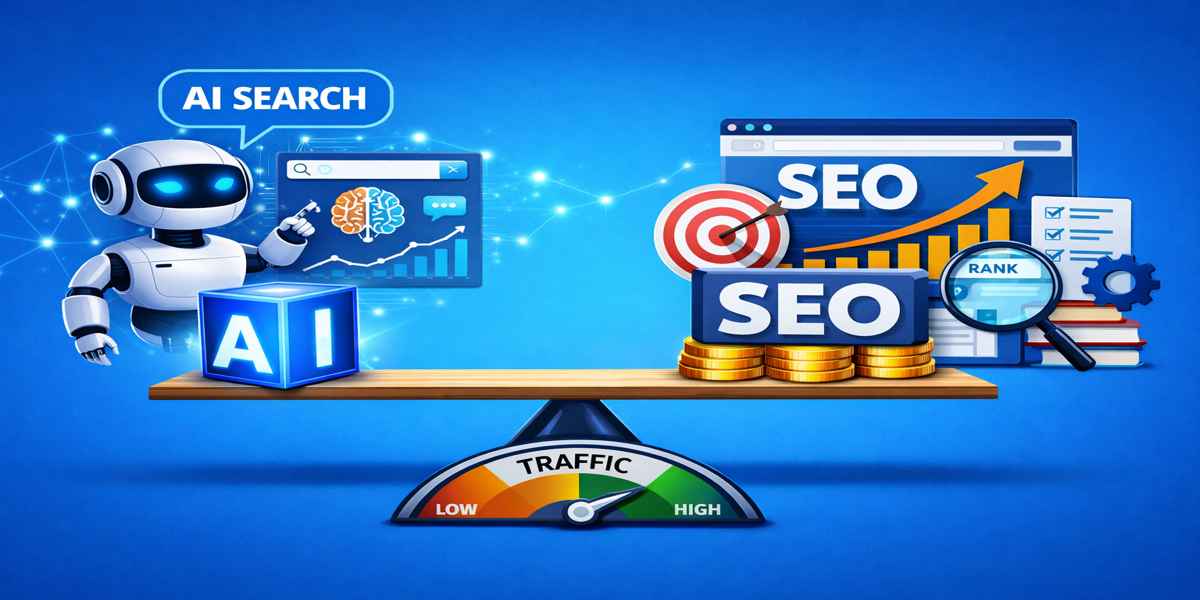
Introduction: Is AI Search Really Replacing SEO?
The question whether search engine optimization (SEO) still matters with the rapid increase in the use of AI search tools such as Google’s AI Overviews, ChatGPT, and Perplexity, is legitimate and a matter of concern to many marketers. Nonetheless, the surprising truth is that the basics of SEO still account for the majority of the website traffic today.
AI search is indeed growing, but it is not replacing the search engines, it is building on them. Knowing how the two interact is the factor that determines whether a brand will be among the ones that experience growth or one that panics.
How Is AI Search Growing, and Why Is Everyone Talking About It?
AI search is a set of search experiences that use large language models to provide short answers, suggest sources, or engage in a dialogue instead of displaying ten blue links.
Google search results with AI-powered and generative AI answers are becoming more visible, especially to those who are looking for information. This change is leading to the belief that the traffic coming from organic search is decreasing.
However, a deeper dive into the actual traffic data of various industries shows that the adoption of AI search is still much less as compared to the traditional Google search. The majority of the people still go to websites when looking for details on products, services, or solutions.
Secondary keyword used naturally: AI-powered search results, generative AI answers
Does AI Search Actually Reduce Organic Traffic?
The brief response is: not just yet, and not for most cases.
Although summarizing is the core of AI search, it still selects the best sources, and hence still mainly takes from the highest-ranking pages. If your site is already a good ranker, the AI summaries might give more clarity of visibility for the brand rather than taking away clicks.
According to SEO consultant Mark Reynolds, “AI search reallocates attention. It does not wipe out traffic. Sites with strong SEO fundamentals still prevail.”
So, a large portion of websites’ traffic that is driven by search engines is still over and above that coming from AI tools in terms of volume and consistency.
Why Do SEO Fundamentals Still Drive Most Traffic?
Competitors agree with each other in this matter, and the data corroborates it.
The basics of SEO such as keyword research, search intent matching, technical optimization, and helpful content still form the foundation of visibility. AI tools exhibit the same characteristics as Google over the years: relevance, authority, and trust.
If your web pages are quick to load, provide accurate answers, and display professionalism, they will get a higher chance of appearing in both classic search results and AI-generated summaries.
We already have had a discussion on how a strong SEO strategy adapts to algorithm changes in our article on modern search visibility, and the same principles apply here.
What Role Does Content Quality Play in AI-Driven Search?
Content quality is very important now and then, just in a somewhat different way.
AI systems love easily readable, well-structured, and expert-backed content. Thin, keyword-filled pages struggle while helpful guides flourish.
That is why content optimization for search engines still works. AI does not create knowledge from nothing; it draws from trusted sources already ranking high.
Nina Lopez, a content strategist, states, “AI won’t substitute content creators, but it will boost the ones who consistently create value.”
Should SEO Strategies Change Because of AI Search?
Yes, but not in the way many fear.
Rather than letting go of traditional SEO, savvy marketers are stretching it. That implies putting more emphasis on topical authority, clear answers, and organized formats like FAQs and how-to guides.
For instance, the merging of conventional keyword targeting with conversational phrasing improves the content’s performance in both classic search and AI-assisted results.
If you are complying with best practices like the ones we outlined in our guide on search-friendly content creation, you are ahead of the competition.
How Can Businesses Prepare for the Future of Search?
The future isn’t about “AI search vs SEO.” It’s about AI search plus SEO.
Businesses that continue to focus on the basics while making their content suitable for AI visibility will win the traffic from both channels. This means enhancing internal linking, amplifying expertise signals, and being consistent.
Google has even pointed out that the main ranking factor, no matter how results are displayed, is still the helpful, people-oriented content.
FAQs
Is AI search replacing Google search?
Not at all. The AI search applications are tightly coupled with Google-indexed outputs and the share of total search traffic being represented by them is still very small.
Does SEO still work in 2025?
Yes. SEO basics such as relevance, content quality, and technical performance will continue to be the main drivers of organic traffic.
Should I optimize content differently for AI search?
Concentrate on clear explanations, useful responses, and well-organized content. These enhancements are useful for both AI and traditional search results.
Will AI summaries reduce website clicks?
In some instances, yes, but good rankings most of the time also lead to increased brand visibility and long-term traffic gains.
Is SEO worth the investment if AI continues to grow?
Absolutely. The AI search process relies on the SEO-optimized content, therefore, it is not a question of SEO being less important, but rather the opposite.
Conclusion: SEO Isn’t Dying, It’s Evolving
There is no denying that AI search is growing. However, the notion that SEO is becoming irrelevant does not stand. The fundamentals of SEO still drive the majority of traffic, and they are also the ones powering AI search results behind the scenes.
If you concentrate on producing valuable content, knowing your audience, and following the proven SEO basics, you are not lagging behind, you are securing your growth for the future.
What’s your opinion about the impact of AI search on your traffic? Please leave a comment or share this article with someone who still fears that SEO is dead.

Kumar Swamy is the CEO of Itech Manthra Pvt Ltd and a dedicated Article Writer and SEO Specialist. With a wealth of experience in crafting high-quality content, he focuses on technology, business, and current events, ensuring that readers receive timely and relevant insights.
As a technical SEO expert, Kumar Swamy employs effective strategies to optimize websites for search engines, boosting visibility and performance. Passionate about sharing knowledge, he aims to empower audiences with informative and engaging articles.
Connect with Kumar Swamy to explore the evolving landscape of content creation!