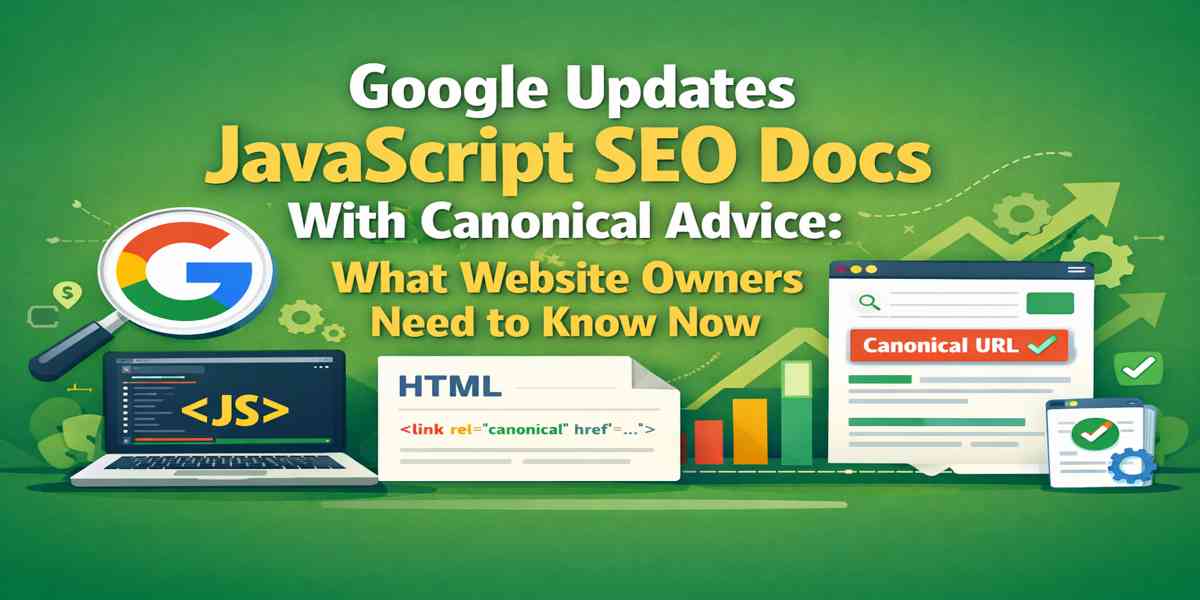
Why does it happen that the “wrong” page actually gets indexed by Google sometimes, however hard you may try to get it right? It’s a feeling and thought that lots of us share. Just because of that, Google decided to tweak its present JavaScript SEO documentation and came up with some more canonical recommendations. Obviously, everyone needs to be well aware of this update.
This change could be crucial for how Google will understand and rank your pages if your website uses JavaScript frameworks like React, Angular, or Vue.
What, in particular, did Google change in its JavaScript SEO documentation?
Google just updated its JavaScript SEO documentation to clarify how canonical URLs should be handled when JavaScript is present. Previously, most developers thought that Google would always follow end-to-end canonicals. The update promotes a much better interpretation of it.
Google has now officially emphasized that canonical tags should be put in place in the first HTML response, not somewhere on the page by running other post-loading JavaScript. This will help the google bot, essentially making it understand the connections between pages better and quicker during the crawl and indexing process.
This latest update comes at a time when the most updated canonical URL best practices confirm the view of those who believe technical SEO still matters, even in this new age of JavaScript frameworks.
Canonicalization advice for JavaScript websites are of utmost importance because?
The biggest problem with JavaScript SEO is that Google processes pages in a two-phase manner, namely –crawling and rendering. So if your canonical points out only after JavaScript loaded, Google might have already made indexing decisions before seeing that.
When one aims to build sites using prominent JavaScript frameworks while constantly catering to possible search engine issues, the lesson that will come up, at most gently, is “don’t make Google wait.” Address those signals swiftly.
As a technical SEO guru rightly says, “Google can reportedly render JavaScript, but that doesn’t mean you should rely on rendering for critical SEO signals like canonicals.”
How does this heavy reliance on JavaScript affect crawling/indexing?
All of those updates directly affect JavaScript rendering and indexing. So, unless canonical tags are present within the raw HTML code, Googlebot will maybe temporarily index multiple URLs or use its own canonical URLs at its own discretion.
So the key here is placing the canonical tags in the server-rendered HTML so Google knows what page version to place new content on already even before the JavaScript loads. This is paramount for big eCommerce sites and content-heavy platforms where efficient crawling is a must.
What should developers and SEOs be doing differently post-COVID-19?
First, do an audit of the page itself. Take a look at the source code and check if the canonicals show up just within the raw code of the page. If they don’t, that’s your first red flag.
Moreover, as one may see, server-side rendering (SSR) or dynamic rendering is a good approach for the critically important pages, especially in the presence of all tools such as React, Angular, or Vue. This is one such instance of the update performed on a hands-on project way subordinate to conventional programs, such as SEO modules which we talked in detail about the digital marketing training resources on iTech Manthra.
Does this affect how Google deals with duplicate content?
However, can they, although not directly, as they contributed to duplicate content SEO in a major way. So, when they were delayed, or simply absent in the case with the JavaScript method of timing, Google might look at similar URLs as separate pages.
The most important thing is that Google is now saying even more implicitly than before. Make your URLs perfectly clear, fast, and accessible with little attention to JavaScript execution.
After this update, do you think JavaScript is still great for SEO?
Yes, of course. It is not so much the JavaScript that Google condemns. It just suggests that website owners follow the protocols of Google JavaScript SEO more closely. The view is quite simple JavaScript is highly powerful but canonicals, meta tags, structure data, and all such SEO signals should stay straightforward enough for search engines to follow.
“Just as JavaScript isn’t the enemy, neither is search engines or their algorithms,” says SEO strategist Rahul Mehta.
If you are curious about their fit with SEO career combines and the evolving trends of modern search marketing, best SEO foundational texts on iTech Manthra have some good solutions.
FAQs
Will Google ignore a canonical published in JavaScript?
Not necessarily; Google often assistant canonical ones programmed server side; these get indexed better and faster.
Is server-side rendering necessary for JavaScript SEO?
No, but it ensures that your crucial SEO elements, including the canonical URL, are understood well by search engines.
Could this update affect a website’s ranking?
Yes, it could, as over the long term, JavaScript-dependent canonicals would lead to a discrepancy in indexing.
Will this update be relevant to static-site users?
Not much. This could mean that websites that get JavaScript and are dynamically rendered being most affected.
Is this change important for beginners studying SEO?
Yes. It’s a great example of why technical SEO basics matter, even today.
Conclusion
While Google’s update is not huge, being up-to-date is pertinent. One concern also refreshes SEO as the web becomes more and more technology-based: its fundamentals stay essentially the same. Clean canonicals, simple HTML, and seriously great tech setups win the day.
If the page uses JavaScript, do review with prejudice which other to send SEO sign from your page to google and fix that to guard your SEO ranking from being in hot water if overlooked.
If it helps you, do leave a comment with an “upvote.” Also, you may distribute that to your programming team if these changes interest you. The idea remains that when we learn together, SEO changes end up becoming much easier, doesn’t it?

Kumar Swamy is the CEO of Itech Manthra Pvt Ltd and a dedicated Article Writer and SEO Specialist. With a wealth of experience in crafting high-quality content, he focuses on technology, business, and current events, ensuring that readers receive timely and relevant insights.
As a technical SEO expert, Kumar Swamy employs effective strategies to optimize websites for search engines, boosting visibility and performance. Passionate about sharing knowledge, he aims to empower audiences with informative and engaging articles.
Connect with Kumar Swamy to explore the evolving landscape of content creation!