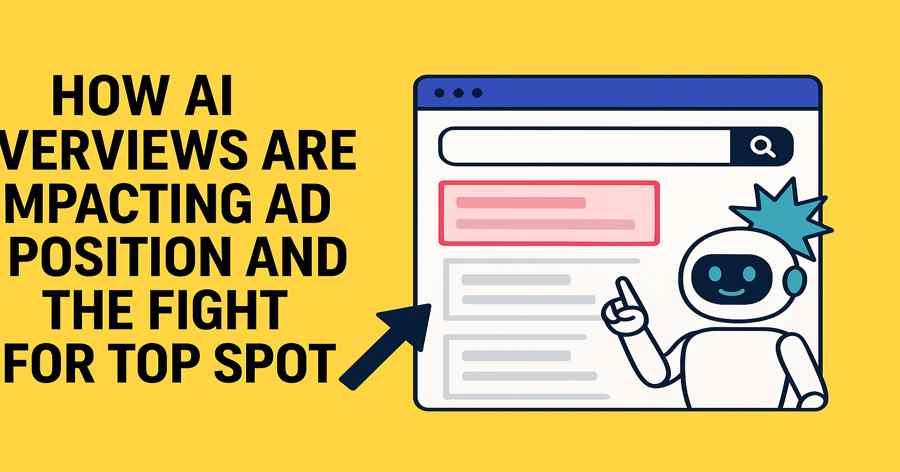
Why are advertisers suddenly feeling uneasy about AI Overviews pushing their ads down the page? Because it changes not just where ads appear, but how users discover answers. If visibility drops, clicks drop, conversions drop and that’s a real revenue problem.
Let’s break down what’s really happening, how AI Overviews shape ad placement, and what marketers can do to stay competitive.
What exactly are AI Overviews doing to search results today?
AI Overviews (also called AI Summaries) are taking the most important answers from across the web and placing them above traditional search results. Naturally, this pushes everything else organic listings and ads alike lower on the page.
This is similar to featured snippets, except AI Overviews take up more space and influence user actions even before ads appear.
Some ad accounts are reporting 10–28% drop in impressions when AI Overviews appear above ads. Marketers selling competitive products like software, e-commerce products, or financial services have started feeling this sooner.
How AI Overviews are impacting ad position and the fight for top spot?
AI Overviews expand to a long detailed panel. Below it, Google may or may not show ads at the very top. When ads fall below, CPC becomes less predictable because:
• The competition for the remaining “prime positions” increases
• Advertisers need to be aggressive with bidding
• CTR (click through rate) sees noticeable decline
One advertiser said something that stuck with me:
“It’s like running a store where the entrance was moved to the side without telling the customers.”
This is why there’s a big debate happening marketers trying to win the top ad spot now face a new “overlay” sitting above them.
Why does this matter for SEO & PPC teams working together?
Before AI Overviews, SEO and PPC teams worked independently. Now they can’t.
If your SEO content isn’t strong, AI Overviews won’t pick data from your site. If your PPC ads don’t align with AI answers, they look irrelevant.
You need to sync:
- PPC keyword targets
- SEO topical authority
- Landing page signals
- Helpful content aligned with user intent
Are AI Overviews affecting branded keyword performance too?
Yes. Search terms like “best CRM tools for small business” now show AI-generated suggestions, listicles, summaries, and brand mentions even before ads appear.
When AI gives answers upfront, the buyer journey gets shorter.
Some brands are experimenting with creative bidding strategies to stay top-of-mind. Others are building informational pages that AI Overviews can reference.
What strategies help advertisers win this new “AI-first SERP”?
To compete smartly, marketers are doing 4 things:
1) Align ad copy with AI intent
If AI talks about pricing, value, free trial, or customer support, mirror that in the ad.
Secondary Keyword: PPC Optimization Strategy
2) Improve topical depth on landing pages
Thin content won’t cut it. AI Overviews pick comprehensive sources.
We recently wrote How to dominate video driven SERPs A Complete Guide for Modern Marketers which explains depth signals clearly.
3) Focus on zero-click search protection
People consuming answers above ads means fewer clicks, so brands must measure assisted conversions, not just direct ones.
4) Study AI Overview triggers
Not all search queries show AI Overviews (especially transactional terms). Target those opportunities aggressively.
Expert insight: what do marketers say about this shift?
Here’s a quote from a PPC lead we work with:
“AI hasn’t canceled paid ads, but it has changed user attention. Winning eyeballs needs smarter messaging, not just higher bids.”
And another from a search strategist:
“Brands that add depth, context, and proof are the ones AI trusts. The goal isn’t just ranking it’s relevance.”
Will CPC go up because of this?
Short answer: Yes, but not everywhere.
- For informational keywords: CPC drops slightly
- For transactional keywords: CPC rises due to higher bid pressure
This is why smarter targeting, landing pages with helpful content, and continuous testing improve results.
External perspective summary
A popular marketing journal recently discussed how visibility loss in AI-driven SERPs forces advertisers to rethink ROI tracking not just pure clicks. (External Mention)
FAQs (quick and practical)
1) Do AI Overviews appear for all search queries?
No. They show mostly for informational and mid-intent questions.
2) Are ads disappearing from Google results?
No, but they may appear lower when AI Overviews sit on top.
3) How can advertisers maintain CTR?
By aligning ad copy with the same topics that appear in AI answers.
4) Will CPC increase for everyone?
Only for competitive transactional categories where AI pushes ads downward.
5) Can brands influence AI Overviews?
Yes by building deeper, more helpful content pages with clear expertise.
Conclusion
the “fight for top spot” is now about context, not position
AI Overviews aren’t killing ads. They are simply forcing marketers and brands to be sharper, more strategic, more human, and more helpful.
The best results don’t come from pushing harder they come from aligning with what users actually want to see.
You’re welcome to share your thoughts below. Do you see AI Overviews helping or hurting your campaigns?

Kumar Swamy is the CEO of Itech Manthra Pvt Ltd and a dedicated Article Writer and SEO Specialist. With a wealth of experience in crafting high-quality content, he focuses on technology, business, and current events, ensuring that readers receive timely and relevant insights.
As a technical SEO expert, Kumar Swamy employs effective strategies to optimize websites for search engines, boosting visibility and performance. Passionate about sharing knowledge, he aims to empower audiences with informative and engaging articles.
Connect with Kumar Swamy to explore the evolving landscape of content creation!